
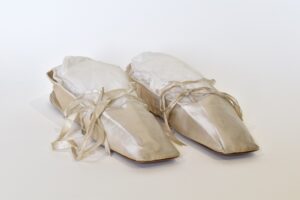
“In an upper room in a house in an English village, inside a glass case, sits a small pair of white satin dancing slippers. The house, in the village of Chawton in Hampshire, was the last home of Jane Austen, and the slippers belonged to her niece, Marianne, who would be the last person to record first-hand memories of the author.” – May, Lou and Cass, Jane Austen’s Nieces in Ireland, by Sophia Hillan.
Last December, I was in England celebrating a Milestone Birthday (I won’t name it, but will say I am almost twice as old as Jane Austen ever got to be!), and some friends in Oxford took me to a wonderful exhibition of Treasures of the Bodleian Library. This was at the Weston Library, home of the Bodleian’s Special Collections, a handsome modern building in Broad Street where, after viewing the historic, eclectic variety of treasures, you can sit in the café and watch Oxford go by.
Imagine my delight when I came across a couple of items relating to Jane Austen. Her own manuscript music-book was there, with musical pieces copied out in her own hand. This was on loan from Jane Austen’s House at Chawton, and I had seen it before, so I was actually more entranced by seeing a pair of pristine, fairy-like slippers, that had been worn by Jane Austen’s niece, Marianne Knight. They were also from Chawton, but fresh and new to me, with the airy look of ballet slippers that had never been worn. The plaque reads:
“These slippers belonged to Austen’s niece, Marianne Knight, and date from the early 19th century. Fashioned in white satin with square toes and tie ribbons, the heels are lined with chamois leather and the toes with linen. [The soles are pigskin.] From their fine condition we must assume these slippers were never worn.”
The slippers are so delicate and flimsy, it seems miraculous they have survived from the early 19th century, still looking as if they just came out of a bandbox. (Slippers at that date had no designated right or left, which adds to the balanced identical appearance.)
I was charmed, and remembered a little I had read about Marianne. She was one of the large family of Jane Austen’s brother Edward Austen-Leigh, who took the name of the Leigh family when he was adopted by his wealthy cousins and inherited their estate. His wife Elizabeth died after giving birth to her eleventh child, one of several of Austen’s sisters-in-law to meet such a fate. We can speculate on this family history having contributed to Austen’s decision not to marry but to devote herself to her writing, and to her family.
Seeing the slippers made me want to learn more about Marianne. Interestingly, she was the young relation who was considered to be the most like Jane Austen, in both appearance and wit. Her life also had parallels with Jane’s own, for she never married and spent many years in her brothers’ homes, and busy with auntly duties. (We may remember Jane Austen writing about “the importance of aunts.”)
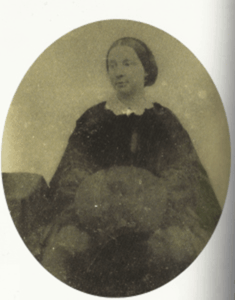
Marianne Knight
Jane Austen had been especially close to Edward’s eldest daughter Fanny, who became substitute mother to the brood of younger children. Fanny and the next eldest sister, Elizabeth, were privileged to spend time with their aunt, listening as she read her novels in progress to them. Marianne, the third sister, was not allowed to be in the room while the readings were going on, but she was the one who vividly wrote about it: “When Aunt Jane came to us at Godmersham she used to bring the manuscript of whatever novel she was writing with her, and would shut herself up with my elder sisters in one of the bedrooms to read them aloud. I and the younger ones used to hear peals of laughter through the door, and thought it very hard that we should be shut out from what was so delightful.” Marianne was age 17 when her aunt died, and remembered her well, particularly how she took her to the theatre for her twelfth birthday.
Also when Marianne was 17 she took over the running of the large Godmersham household, after her two older sisters married. She nursed her father in his old age, and afterwards was dependent on her brothers, much as Jane Austen was. She cared for her brother Charles and his rectory at Chawton for many years, later moving in with her youngest brother John. After his death, Marianne, at age 78, the only sister never to marry, was essentially homeless. Her younger sister Cassandra had married Irish Lord George Hill, and died of puerperal fever after giving birth to a seventh child. Another younger sister, Louisa, subsequently married Lord George, and it was to help her care for her dying husband, that Marianne moved to Ireland. There she died in Donegal, at age 95, the last of the eleven children. Sophia Hillan, author of May, Lou and Cass: Jane Austen’s Nieces in Ireland, observes that Marianne fell into the role of “the good, sweet, uncomplaining spinster aunt, and added, “She began her life as an Emma Woodhouse figure, the daughter of a great house…but ended as a Miss Bates.” “It is the fashion to be poor, and so of course I am,” she wrote wryly in old age.
Nevetheless, Marianne seems to have had a cheerful, humorous, resilient nature, and always remembered her aunt’s delight in the family charades. In her old age, she was given her Aunt Jane’s charade book, and with her memory perhaps fading, she commented, “I knew she was clever but in what way I did not know.” A relative wrote about Marianne’s own wit: “She was the originator of many stories and sayings, some of which got into Punch, I believe.”
It is pleasing to think of another description of the young Marianne, as having worn “white satin dancing shoes during her first ball season” and being considered “bewitching beautiful.” Which makes me wonder – were the white satin dancing slippers that I saw, replacements for the ones she wore during her first season? I leave it to yourselves to determine…

4 comments
Skip to comment form
Lovely recollection. The word slippers always refered to footwear having no identifiable left or right. It is one of those words who’s meaning has altered over the years to indicate footwear specifically designed to be for indoor use
Author
Thank you – good to know! I wonder when rights and lefts *did* come in. These look like they wouldn’t survive a single night’s dancing, and would be soiled after a few chasses.
I was asked if there would be shoe-roses in this story. You see there are none, though they are mentioned in Pride and Prejudice!
It’s amazing how things so delicate can survive over two hundred years! I agree that had they been worn they probably wouldn’t have survived two balls! They do look comfortable. I visited the fashion museum in Bath in 2011 (at that time it was below the Assembly Rooms) I loved it. I also saw the fashion display in the Victoria and Albert in 2000 and the display in Shambellie House in Dumfries in 2006. I’ve always been fascinated by it and loved this post thank you. 🥰🥰
Author
Dear Glynis, thank you for your kind comment, and I’m so glad you liked this snippet – no surprise it would appeal to the sensibility of one who enjoyed the fashion museum in Bath (me too!) and the fashion treasures in the V&A (me too!) – but I have never been to Shambellie House in Dumfries! Most fortunately for me, I am going to spend this summer in Edinburgh, so I am now wondering if I might be able to go to see it as a day trip. Just looked it up – it’s rather a journey, 2.5 hours each way, but not impossible…Thank you for putting it into my head! All best wishes, Diana