
Ever heard of Self-Control by Mary Brunton? Probably not—unless you stumbled across it through Jane Austen’s letters or a variation that mentions it.
Back in 1811, though, Self-Control was the book. Huge. Everyone was reading it. Meanwhile, Sense and Sensibility? Not so much. Funny how that turned out.
Austen herself was trying (and failing) to get a copy, writing to Cassandra that she was “half afraid” of finding it too clever and discovering her own ideas already done better. Which makes Jane kind of relatable, actually. It’s tough to think of her as a new writer, but she was, once . . .
So what was all the fuss about?
Mary Brunton, a Scottish author, wrote Self-Control as a kind of moral adventure story. Her heroine, Laura Montreville, doesn’t just fend off unwanted attention, she survives increasingly wild, borderline unbelievable dangers. At one point, she fakes her own death and escapes by tying herself into a canoe and shooting down river rapids. Yes, really.
It’s dramatic. It’s intense. It’s . . . not exactly Austen.
Where Austen’s heroines navigate drawing rooms and social landmines, Brunton’s are out here dodging unwanted “suitors” and actual physical peril. And readers at the time loved it. The book went through three editions in six months, and Brunton followed it up with another hit, Discipline.
Austen did eventually get her hands on Self-Control, and her reaction was priceless. She calls it “elegantly-written” but basically impossible to believe, then zeroed in on that canoe escape with the kind of sarcasm only she could level. She even joked about “improving” on Brunton’s story by sending her own heroine across the Atlantic the same way.
But Austen didn’t just dismiss Brunton. She read her, reread her, and clearly engaged with her work. Brunton wasn’t a footnote to Austen, she was part of the same literary conversation.
Both writers were exploring the idea of “self-control,” a big moral theme of the time. Austen does it through emotional restraint (Elinor vs. Marianne), while Brunton turns it into something almost heroic—enduring danger, resisting temptation, surviving the improbable.
So why did Brunton fade while Austen became a global phenomenon?
Mostly style. Austen’s wit and sharp social observation have aged beautifully. Brunton’s more moralizing tone and melodrama . . . less so. Plus, Austen got that crucial revival later on with her family supporting her work, while Brunton slipped out of print.
But revisiting Self-Control is actually pretty fascinating. It reminds us Austen wasn’t writing in a vacuum, she was surrounded by other ambitious, popular women writers trying bold things with the novel.
And there’s something rather delightful about imagining Austen reading that canoe scene and thinking, Oh, come on.
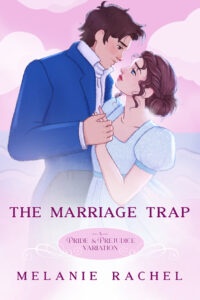
Anyway, since I’m using Self-Control in The Marriage Trap (out next week!) I thought it was worth sharing a bit of the story behind the story.

5 comments
Skip to comment form
Love JA’s response to the believability ( or rather lack thereof) of Self Control! That’s hilarious!
Looking forward to ‘The Marriage Trap’. I’m sure it will be well worth the wait 🙂
Author
Thanks for posting, C!
No, I’ve never heard of it. It was probably more popular due to the unlikelihood of these things happening (much like SciFi nowadays?) Whereas P&P was more like everyday life to those who had access to books in that time!
So, you say you’ve used used this book while writing The Marriage Pact? Please don’t say Elizabeth ties herself to a canoe? 😱🤔😉😂. I look forward to reading it anyway 😉🥰📖🥰
Haha! Even if Elizabeth did tie herself to a canoe I bet that would be exciting (silly and dramatic, but a bit of an adventure too).
I had only heard of the book Self-control mentioned in other JAFFS I’ve read. I like hearing about books/authors that would have been contemporaries of that time period.
I love hearing about the books that Jane Austen would have likely read, but most of the time, I’d rather be reading Jane Austen or JAFF than her contemporaries. Thanks for summarizing the story so I don’t have to read it. Rebecca Romney’s book, Jane Austen’s Bookshelf, inspired me to read Maria Edgeworth’s novel, Belinda. While I enjoyed reading the novel, the pace was excruciatingly slow. Are there any others you’d recommend?