
A picnic sounds simple, right? A basket, a blanket, a shady tree, good things to eat, maybe some lemonade.
But in the Regency era, it was more complicated.
The word “picnic” had already appeared in English by the mid-eighteenth century, but by the Regency period it had become associated with genteel outdoor dining, especially among those wealthy (Lee, 2019). 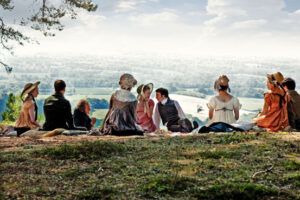
In practice, a picnic was not merely “let us eat outside.” It was an undertaking. Food, linens, plates, cutlery, cushions, servants, amusements, and any other article that might prevent one’s guests from experiencing even the mildest inconvenience had to be packed and transported.
In The Pemberley Picnic, which is out today, Darcy’s servants only have to move things out to the lawn. This is a very good thing since Darcy doesn’t tell them he’s planned the picnic until after he invites Elizabeth and the Gardiners to join him for it. He mentions this on Friday. The picnic is on Saturday.
That is why I could not resist a picnic for a summertime novella, though of course I’m taking the social awkwardness in another direction. A Regency picnic is the perfect setting for a rom-com. People are outside, but still trapped together. There is food, but also weather, uneven ground, small children getting into things, and the alarming possibility that someone might finally say what they mean.
Here’s a little glimpse from Chapter One:
Miss Elizabeth was departing on Monday.
It was already Thursday, and as Sunday was a day of worship and they would likely leave the area early the following morning, he had only Friday remaining, perhaps Saturday. He had been conducting himself in the belief that there was time for her good opinion to build slowly and at no risk to anyone’s dignity, chiefly his own.
There was not time. “So soon?” he asked.
“I am afraid so.” Mrs. Gardiner’s eyes were on him, mild and far too observant. “The days have passed very quickly.”
And then Darcy, who distrusted impulsive actions on principle, heard himself speak. “Then you must come to us tomorrow,” he said. “We are to have a small party, not unlike the one you recall, Mrs. Gardiner, though with fewer guests. Some of the neighbours to spend the day out of doors while the weather holds so fine. I hope you, Mr. Gardiner, and Miss Bennet will do us the honour of attending.”
Half a second after the words had left him, he recalled that there was in fact, no party planned for tomorrow. There were no neighbours invited, no day appointed, no rugs ordered, no tables, no ice, no lemonade, nothing whatsoever out of doors but a lawn, the river, and a great many trees. He had invited three people to an event which existed only because Miss Elizabeth was leaving Derbyshire on Monday and he had momentarily lost command of himself.
“How very good of you, Mr. Darcy,” Mrs. Gardiner said. “We should be delighted. I can answer for my husband, who would forgo a great deal rather than miss a fine day out of doors and the opportunity for more fishing. And I believe I speak for my niece as well.”
“I should be very happy to attend, Aunt,” said Miss Elizabeth.
“I am glad,” he replied, inclining his head as if this were all perfectly usual.
Outwardly, Darcy was certain nothing showed. Inwardly his mind was frantically at work, because there would now have to be a picnic and it had to be tomorrow. Mrs. Reynolds must be told within the hour and the neighbourhood within two. Lord Biggsworth was not in the country at present, but Mr. and Mrs. Atherton could be applied to, Sir Harold and Lady Carstairs, Reverend Mr. Pelham and his daughters. The kitchens. The cellars. Richard, who would never, as long as he lived, let this rest.
Georgiana was staring at him.
It was the smallest movement, but she had turned to him with her lips just parted, staring at him. She knew, as well as anyone breathing, that her brother did not decide to hold picnics on a morning’s whim, that he did nothing on a whim at all.
He met her eyes and silently begged her to comply. She did not understand, but she offered him a very subtle nod and did not dispute him.
Across the room, Miss Bingley’s fan stopped. “I had no notion,” she said, “that we were to have a party tomorrow.” Her voice was smooth, and her smile was in good repair, but the fan had not resumed.
“It is but lately decided,” Darcy said.
“How . . . spontaneous of you.” She let the word sit. “I should never have thought it of you, Mr. Darcy. You are grown quite reckless. It is the country air, perhaps.”
“The weather is very fine just now,” he agreed, and said nothing further.
It was Mrs. Annesley, bless her good sense, who took up the dropped thread of conversation and asked whether the Gardiners and Miss Elizabeth had yet seen the falls at Matlock. They had, as it happened, and the morning carried on.
Georgiana recovered her courage from somewhere—perhaps from the discovery that her brother had just done a thing more frightening than anything she might be asked to do—and she managed to say to Miss Elizabeth that she hoped she was fond of being out of doors.
“Excessively,” said Miss Elizabeth. “It is nearly the only thing I do well.”
That was not true, but it was very like her to say so.
They did not stay much longer after that, and Darcy, watching the clock while his mind drew up lists, knew the call had reached its natural end. He saw the ladies to the hall himself, walked a half-pace too near Miss Elizabeth, and handed Mrs. Gardiner into her carriage.
“Until tomorrow, then, Mr. Darcy,” Mrs. Gardiner said, settling her skirts.
“Until tomorrow.”
He held out his hand to assist Miss Elizabeth. It was the briefest contact. A gloved hand in his, the light pressure of her fingers, nothing that could not be done before every eye in Derbyshire.
Still, she met his gaze as she stepped into the carriage, and for one foolish instant he felt as if tomorrow had already begun.
“Thank you, Mr. Darcy,” she said, in a voice he would recall syllable by syllable for a considerable portion of the evening to come. Then the steps were up, the door was shut, and the carriage was away down the drive.
Darcy stood there watching it, not moving until it had passed out of sight behind the trees.
Then he turned to go in and met Mr. Leeds in the doorway, who had watched the whole departure from his post.
“Leeds,” Darcy said. “Be so good as to ask Mrs. Reynolds to attend me in the library. At once, if she can be spared.”
“Yes, sir.” The butler did not enquire. But Darcy thought he detected something almost like respect in the man’s countenance, though he supposed it might simply be resignation. “Will there be anything in particular I should warn her of, sir?”
“We are giving a picnic tomorrow,” he said. “I find I have already invited several guests.”
There was no change in Leeds’s face. A lesser man would have blinked.
“Very good, sir.”
“And we shall require rather more than a cold collation.”
Leeds appeared faintly appalled. “Of course, sir.” He bowed and withdrew, his vaunted dignity perfectly intact, while Darcy had the uncomfortable suspicion that his own had been sent down the drive after Miss Elizabeth Bennet.
The Pemberley Picnic can be found here: https://readerlinks.com/l/5513588

Lee, A. (2019, July). The history of the picnic. History Today, 69(7). https://www.historytoday.com/archive/historians-cookbook/history-picnic

4 comments
Skip to comment form
How fortunate is Darcy with his staff? Giving them 24 hours to provide a fully catered picnic!
All because he’s hoping Elizabeth will think better of him before going home. 🥰
Ok so things don’t go perfectly and Caroline is her usual interfering self, 🤔 but this is so definitely a must read!
I loved it enough to give it five stars! Thank you 🥰🥰🥰
Author
They are probably muttering to themselves, but know he’ll pay them bonuses later!
Oh, Melanie, this looks delightful! “. . .for one foolish instant he felt as if tomorrow had already begun.” Can’t wait to begin reading it!
Author
Yay! I hope you enjoy it!