
I had the delightful opportunity this past summer to visit England with my 12-year-old daughter, and we had a wonderful time visiting some of the places where Jane Austen once lived, walked, and wrote her books. This year is the 250th anniversary of her birth, and it sometimes felt as though all of England was gearing up for the celebration! In so many of the places associated with Jane Austen, there was almost a festive feel, with banners and posters and references to Jane Austen everywhere!
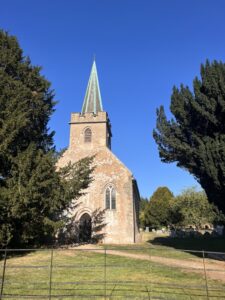
St. Nicholas’ Church in Steventon
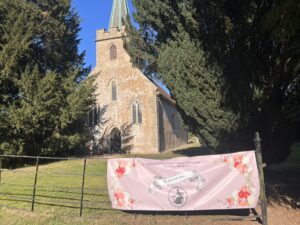
St. Nicholas’ Church displays a banner announcing Steventon as Jane Austen’s birthplace
Jane Austen was born on December 16th, 1775. Her father was rector at St Nicholas’ Church in Steventon, so she would have grown up listening to her father give sermons at that church. While the rectory where she once lived no longer exists, the church is still there, and it even had special displays talking about the Austen family history there. 
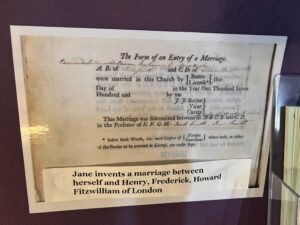
Jane invents a marriage for herself in her father’s marriage register!
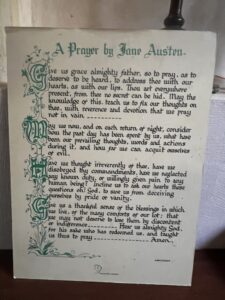
Little hints of Jane’s history and humor were shown in the church as well! A prayer attributed to Jane was beautifully decorated and on display,
and there was also a copy of a page from the marriage register on which a mischievous young Jane invented marriages for herself! On one page she married “Henry Frederic Howard Fitzwilliam of London,” and on another page, “Edmund Arthur William Mortimer of Liverpool.” (While this picture labels it as Henry, it’s actually the entry for Edmund.) I can only imagine her father’s reactions when he discovered her making up fictional marriages for his records!
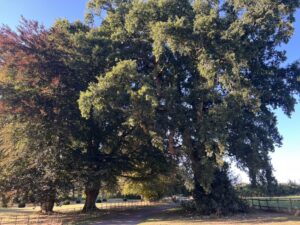
Trees along the lane leading to the church in Steventon
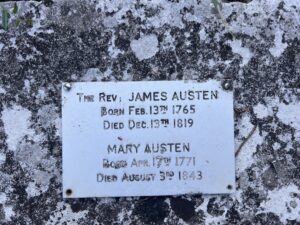
James Austen is buried in the graveyard there, and we walked around and saw several Austen graves.
While we couldn’t walk to Jane’s former house, we did enjoy viewing the area around the church and imagining Jane walking those same lanes with her family.
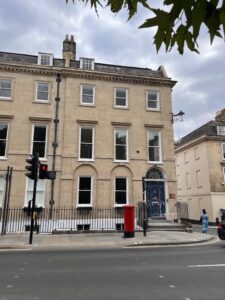
13 Queens Square in Bath
During the years when Jane was living at Steventon, she visited Bath several times. Her brother, Edmund Austen Knight, took 13 Queens Square when he stayed in Bath to take the waters, and she and her mother stayed with him there. Some believe that Catherine Morland’s youthful delight in seeing Bath is based on Jane’s early experiences visiting the city.
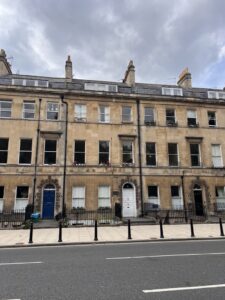
4 Sydney Place
In 1801, Jane’s father decided to retire as rector of Steventon and hand the parish over to his son, James. Some stories talk about Jane fainting when she first heard that her family were leaving Steventon and moving to Bath!
Their first lodgings in Bath were at 4 Sydney Place, fairly close to the beautiful Sydney Gardens where Jane could walk to her heart’s content. From all accounts she seemed pleased with this location. But it was not to last.
After the lease expired at 4 Sydney Place, the family moved to the Green Park Buildings, a place they had initially avoided because of concerns about dampness and illness. There, Jane’s father, Reverend George Austen, died of an illness. After his death, the remaining ladies: his wife, Cassandra, and the daughters Cassandra and Jane, were forced to find cheaper lodgings. Along with a friend of theirs, Martha Lloyd, they moved to 25 Gay Street.
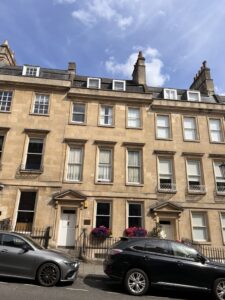
25 Gay St.
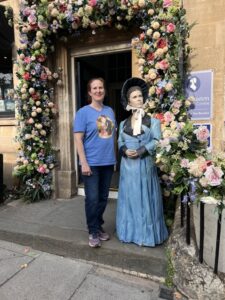
The Jane Austen Centre
While 25 Gay Street is currently an office building, the Jane Austen Centre is located at 40 Gay Street, only a few doors down from the house where Jane once lived! At the Jane Austen Centre, we heard tales of her life story, saw maps of the places in Bath where she once lived, tried on Regency-style clothes, and tried our hand at writing with a “quill” pen. I loved seeing so many fans of Jane’s visit the Jane Austen Centre to discover more about her.
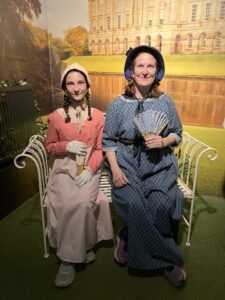
My daughter and I tried on Regency clothes at the Jane Austen Centre
By the time they left Bath in 1806, Jane and her family were happy to escape. The less comfortable lodgings that they were forced to accept in the later years of their time in Bath may have contributed to her description of Anne Elliot’s unhappiness about going to Bath in Persuasion.
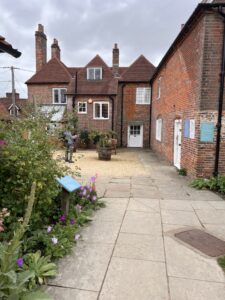
Chawton Cottage yard
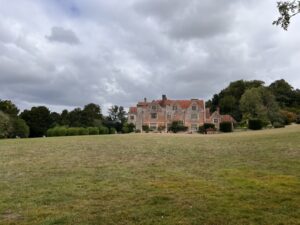
Chawton House from across the lawn
After some time spent with relatives in Bristol and Southhampton, Jane, her mother, her sister, and their friend Martha moved to Chawton Cottage on her brother Edward’s estate. This was a delightful and productive time for Jane. Chawton Cottage and the “great house” were some of my favorite places to visit. Chawton Cottage has rooms set up to show you just how Jane lived, and they’ve done a fantastic job of restoring the house as close as they could to what it was like when Jane lived there. You can sit on a sofa and imagine Jane sitting there, reading Pride and Prejudice to her excited family after its release. You can see a breakfast room recreated to what it might have looked like in Jane’s day, even with wallpaper that they have attempted to restore from a remnant they discovered!
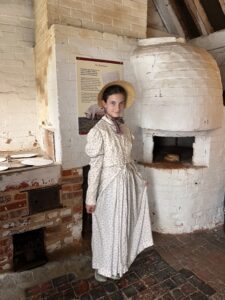
My daughter wearing Regency dress in the bakehouse at Chawton Cottage
Jane often visited her brother and his family, and I loved seeing the beautiful walks around Chawton House, the plaques with Jane Austen quotes that were donated by many of her fans, and the house full of history where she once spent much of her time.
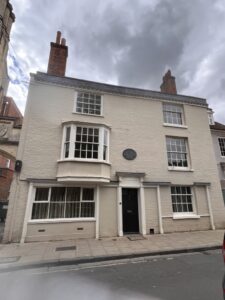
House in Winchester
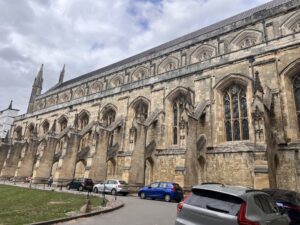
Winchester Cathedral
Jane lived here at Chawton Cottage for most of the rest of her life. In 1817, she grew ill. Her family moved her to Winchester to be near physicians, but she did not improve. She died in Winchester and was laid to rest in Winchester Cathedral.
Visiting all of these places where Jane once lived was an amazing journey. There were some places in which I almost felt that I had stepped into history, and yet at the same time I was sometimes overwhelmed by the changes that 250 years had brought to the places she once knew and loved. The cars lined up in front of the cathedral, the construction in front of the house on Queens Square, the loss of the Green Park Buildings to bombings in World War II, and especially the demolition of the house where Jane lived as a child, all of these were reminders that many lifetimes have passed since Jane breathed her last.
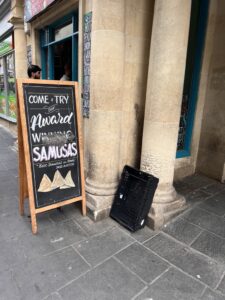
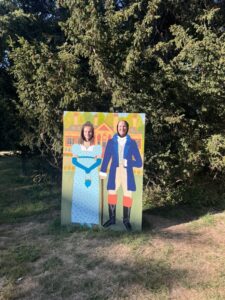 And yet, Bath was full of banners celebrating Jane Austen and her books. My favorite samosa stand had a sign humorously declaring, “Best samosas in town.” – Jane Austen. The church in Steventon had cutouts of Regency characters and a sign proudly stating that it was Jane Austen’s birthplace. The Jane Austen Centre and the Jane Austen House at Chawton Cottage were full to bursting with visitors. The house where she died in Winchester had a plaque for her. The bookshop across the street called itself, “Jane Austen’s Bookshop.” Everywhere, there were signs of the people’s love for Jane Austen.
 Imagine leaving such a legacy that hundreds of years after you are gone, people are still planning costume parades, balls, conferences, and parties in your honor! The impact of Jane’s life, despite how short it was, is still felt in the hearts of every Jane Austen fan the world over. I was delighted to be able to catch a glimpse of it during my trip to England, and I’m so glad I did!

13 comments
Skip to comment form
Who said Jane Austen ever died ? She lives in our memories and through her novels she talks with her fans. She is a LIVING LEGEND.
Beautifully said!
A wonderful post and I enjoyed all the pictures. I was in Bath in 2016 with my daughters. We had a fantastic time and even attended a Regency ball fully costumed. I also got to visit her grave in Winchester. It was a life long dream for me!! I agree about The Jane Austen Centre, a brilliant place to visit for a fan.
That sounds like a delightful tour! I’ve been to some of these sites (especially Chawton Cottage and Chawton House) and I love visiting them again and again. And Bath is my kids’ favorite city in England! It’s so walkable and delightful.
Thanks for this wonderful summary and photos. Loved the little touches, like the samosa sign. Although I wonder what Jane Austen would make of all this brouhaha, I hope she would feel the genuine love and gratitude for her work around the world.
The samosas sign definitely made me laugh! Although they *were* really good samosas, so maybe Jane would have liked them, too! It’s fun to wonder what Jane would think–would she roll her eyes at us? Be honored? Be embarrassed? It’s hard to say! But I do hope that she’d feel the love that we all have for her.
Sarah, thank you so much for your “tour” of Jane Austen’s world. It inspires me to plan a trip to England from Texas to see the places you have written about. I also wish to tell you how much I enjoy your books
Hey Sarah, you took pictures of places that JA lived in Bath. Were any of them still being used as residences? Or were they open and saying that she had lived there?
I’m pretty sure the place on Gay St. is a dentist’s office or something of the kind now. The one on Queens Square looked like it was being used as a residence, although it was being renovated. So either a residence or a small business, I believe. Sydney Place looked like it may be a residence, but it did also have a plaque and pretty flowers, so if it is a residence, they seemed conscious of its history! I believe the place in Winchester has been recently purchased as another site people will be able to visit! And then of course Chawton Cottage and House are both places that you can visit and be steeped in the history of Jane and her family.
Lovely photos and dialogue. My husband and I visited GB for our 25th anniversary and I did visit some of her sites but no where near all you did. Thanks for sharing.
Thank you for this tour of Jane Austen’s life. What a great memory to share with your daughter!
Sounds like a fun trip. Ones of these years I hope to get over there for a long trip to see so much history of the entire UK
What a lovely trip you had! You have inspired me to plan a trip with my girls in the steps of Jane Austen. What fun!