
As my novel The Darcys in Venice glides slowly as a gondola toward hopeful publication, I share a new scene with you, in which Mr. and Mrs. Darcy prepare for their journey.
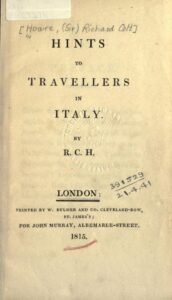
Mr. Darcy’s Guidebook
Now the dark winter evenings at Pemberley became busy ones. The storms moderated, the guests departed, repairs were carried on, and the Darcys were more at leisure to make active preparations for their journey. There was much to do. Guide-books to obtain, and devour; routes to plan, and introductions to envoys and officials to be arranged. Any number of letters were written to friends and connections for advice about the best villas and inns to stay on their route, and there was the momentous decision to consider, of whether the journey should be mostly over water, or by carriage across the Alps.
“I really think,” Darcy told Elizabeth one evening, “that the preparation for a six month journey might fill the entire preceding six-month.”
“It is well that you are able to do it all, then, with such dispatch and efficiency.”
“You flatter me, my dear.”
“Do you suspect me of catching that habit from Miss Bingley? I still smile when I remember her enthusiasm for your penmanship. But you married where you are kept on a scant ration of flattery; if you now have regrets, you have only yourself to blame.”
Mr. Darcy looked up from his correspondence and smiled. “On the contrary, my love, I am well satisfied with my choice, as it gives me the opportunity to strive to please a woman who deserves it.”
“And now it is you who are flattering me, and I who am gratified. What book do you have there now, Darcy, is it Sir Richard Hoare again?”
“Yes; I am convinced that his Hints to Travellers in Italy is the best of all the guide-books. He is practical and direct in his advice, and it is so recent a publication as to have all the new traveling information, collected since the war ended.”
“I am for ever in debt to Hoare, despite the indelicacy of his name. He was so good as to persuade you not to make the journey by sea, as Fitzwilliam’s friends did.” She shuddered. “A watery grave was never my goal.”
“Nor mine, for our family, I assure you. The sea route used to be considered the swiftest way, and the least costly, but the traveler’s tales, of those that survived, were too hair raising for me to wish to emulate them.”
“I do confess I have my doubts about the route across the mountains, despite Napoleon’s improvements,” she admitted. “Engravings of those steep peaks always look so like jagged teeth, as perilous as the sea.”
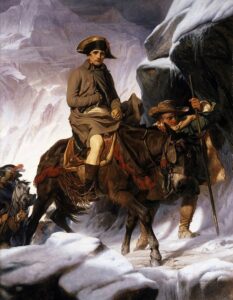
Napoleon crossing the Alps
“You may relieve your mind. We shall have to travel by sea only when crossing the Channel to France, as that can be accomplished in no other way, and then a short water journey before entering Venice, to avoid the marshy countryside.”
“You have become a master of the subject,” said Elizabeth, nestling on the sofa beside him, and looking over his shoulder at the pages of the guide-book.
“Flattery again, upon my word. Or is this your way of saying that I have become quite a Mr. Collins? You must inform me when I am grown too prosy.”
“That would require more of a change, perhaps, than can be in human nature. Nothing could make a Mr. Collins of you. No, at least one of us must become expert in matters of travel, and I am glad it is not myself. Now, do tell me what this writing Hoare says about the carriages themselves, I pine to learn.”
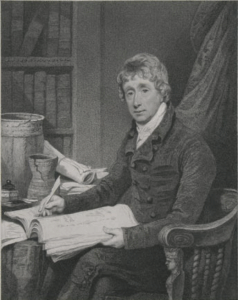
Sir Richard Hoare
“Of course I will, Elizabeth, but Sir Richard is deserving of our respect.”
“Why? Because he is a baronet?”
“Rather because he is an archeologist, and a famous traveler. He dug up Stonehenge you know, and purchased the Glastonbury Tor.”
“Then I must listen to him, by all means. Go on, my love, about the carriages.”
Her husband obligingly read, “The way of travel for a family must be en voiture – that is, in a carriage. Families should indulge themselves with the comforts of a strong built English coach, chaise, or barouche.’”
“I cannot conceive how that may be done. Must we bring our own voiture, does he mean? But a carriage cannot cross the water to France. Do we purchase something abroad, or travel post? Let me know our fate.”
“‘Large assortments of carriages are kept for hire at the great Inn of Calais, or a new one may be purchased at Paris.’ There, Elizabeth. Does that not seem convenient enough?”
“It sounds almost too easy,” Elizabeth observed. “What modern times we do live in. Information is so easy to obtain nowadays, no one need ever stay at home. Think of us going adventuring! Whatever I imagined for myself as a girl, it was not purchasing a barouche in Paris. Will we spend any time there? If we do, I shall be tempted to chuse a bonnet apiece for my mother and sisters.”
Mr. Darcy took no notice of this frivolous sally. “I think our aim in this trip,” he said seriously, “should not be to attempt to see the Continent entire, but to move with as much dispatch as possible toward our principal object, that is, to settle in Venice for some months.”
“I am of the same mind. But surely our guide has something to say about our object?”
“Oh, yes. I can inform you of exactly what he says: ‘Every traveler ought to have two objects in view. One, to amuse himself: the other, to impart to his friends the information he has gained.”
“He does sound like a sensible man,” Elizabeth conceded. “And evidently an adventurous and an observing one, even though he is a baronet.”
“I told you he was. And I shall go so far as to take his suggestion about Paris, for I am persuaded that we should pass some time there, for diversion, as well as arranging the purchase of two of those strong carriages, for ourselves and servants.”
“That is well thought of,” said Elizabeth, clapping her hands with pleasure. “Now, how many people do you suppose we should bring? Nurse, of course, and cook, and a man or two I dare say.”
“Yes, at the very least. I have not decided on Thomas or Edward, or both. Sir Richard recommends engaging a courier, versed in all the languages, in addition to our own servants. However, I would rather trust our own people than a stranger who might prove a villain, as we have not much Italian ourselves.”
“No, to be sure not, though you must have seen me with my head in two or three Italian books, ever since the idea of our going there occurred to us,” she reminded him brightly.
“We will depend upon your learning,” he said solemnly. “You will be able to tell us all about the time Petrarch spent in Venice, in the fourteenth century. The children will be most edified.”
“We will be, any way; and I am bringing their favourite picture-books to entertain them.”
Darcy was not to be distracted from his own preparations. “What do you think, Elizabeth, about Sir Richard’s recommendation to hire an Italian servant ‘chi sa faine la cucina,’ that is, to cook for us, and navigate the markets?”
“Why should we? We shall be staying at inns and villas and have our own English cook along. I do suspect Hoare is living up to his unfortunate name, in soliciting all manner of servants for our hire.”
“Such ribaldry is worthy of Italy, my dear, and we are not residing there yet,” Mr. Darcy chided smilingly. “What would Lady Catherine say to you?”
“I shall soon be out of reach of her censure,” Elizabeth replied cheerfully.
“And never in mine,” her husband answered. “Seriously, we are not bound to adopt all our cicerone’s suggestions. It is only advice. Though I dare say we shall encounter other travellers, who will do exactly what he says, to the letter.”
“We will be more discerning than the general run of tourists. Is his book so very popular?”
“I should say so. It has sold more than a thousand copies since it first came out in 1815. The publisher, John Murray, also publishes Lord Byron, you know. Perhaps that accounts for the book’s success.”
Elizabeth laughed. “I wonder if our traveling entourage will live up to his Lordship’s standards. I have read that when he left England, he modeled his own coach on that of Napoleon. What grandeur!”
“I aim only for decent comfort and safety, appropriate for a gentleman’s family,” he replied. “We need hardly take Lord Byron for our model. And the guide-book has sensible suggestions for all sizes of families and their various means. The most crucial thing of all, I gather, is to be provided with sufficient letters of credit. As the writer puts it eloquently, ‘otherwise the wheels of Italy will turn but slowly.’”
“Then we must ensure that our funds will serve to make our carriage wheels roll smoothly, and the journey as easy as possible,” Elizabeth concluded. “And when shall we depart? We have been planning our venture so long that you might have read ten such books.”
“When ten this good have been written, I assure you I will read them all,” said Mr. Darcy. “Now, you see he does advise on the best time to depart.”
“I felt sure he would,” murmured Elizabeth.
“Just one more snippet, if I may I read you what he says on the subject,” said Mr. Darcy eagerly.
“I see that it will make you happy to do so, my love, and I have no objection to hearing it, though I do not promise to book passage to Calais on whatever day he orders.”
“No such thing. He says, ‘I would leave England the end of April, and devote the month of May in Paris, where I should suppose that time, if well and assiduously employed, would amply satisfy the curiosity. From Paris I would proceed through Lyons to Geneva…”
After a few paragraphs, Mr. Darcy looked down at his wife, whose head was nestled on his shoulder. She was asleep.

4 comments
Skip to comment form
Just as I would suspect, Darcy won’t take any chances with his beloved family so is planning the journey as safely as possible. Elizabeth is obviously very appreciative and totally enthralled 🤔😏😳💤💤
Author
Thanks for commenting, Glynis. It was interesting to research guidebooks and travel diaries of that exact period, and to see what they would have seen and felt on their journey. (I left out the fleas though!)
Thank you for this charming glimpse of the Darcys bantering about their trip. Although I can’t travel without regard to cost the way the Darcys can, I share their enjoyment of seeking advice from trusted travelers and planning some adventures before I depart. I look forward to reading the book!
Author
Thanks for enjoying, I am so pleased! Book is on its final polish. I felt it needed some scenes in the beginning, showing how they started planning their trip – makes more sense when they start on their adventures. Please stay tuned!