
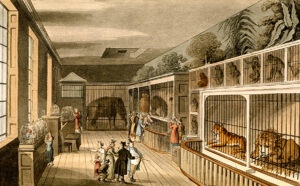
Elephant at Exeter Exchange, 1812
You don’t have to be a pachydermophiliac to delight in a very delectable question, whose origin may be traced to a discussion on one of the Jane Austen online lists from as far back as 2011 – this post is what one might hopefully and tactfully call An Old Classic. Research has not revealed whether the inquirer had been drinking pink champagne, but the question at hand, now and forever, is: Did Jane Austen ever see an elephant?
My feeling is that she did. She was quite familiar with the phenomenon of wild beasts being exhibited, as can be seen by her reference in Sense and Sensibility to children being taken to such exhibits: “We were obliged to take Harry to see the wild beasts on Exeter exchange…”
What was this Exchange? As the question originated online, it is appropriate to research it online, and Google obligingly tells us: “Before the establishment of Zoos, collections of wild animals could be seen at 17th-century fairs, and in 1793 a man called Pidcock established Exeter Exchange, a menagerie on the Strand in London. It was in the 19th century that menageries reached the height of their popularity. This was partly because overseas trade encouraged a market in the animals but also because there was a real interest in seeing wild animals in the flesh. Such was the popular interest in unusual animals that the slaughter of an elephant at the Exeter Exchange was reported in the daily newspapers, complete with details about the dissection of the poor beast.” The London Zoo website reveals that elephants were kept there for 170 years, which means that The First Elephant took up residence in 1835, after Austen’s time. But that doesn’t preclude her from the status of having seen an elephant at one of the menageries.
Jane Austen may have visited Astley’s, where John Knightley takes his family and Harriet and Robert Martin, in Emma. Elephants were exhibited there, though at a later date. In Jane Austen’s time Astley’s was almost entirely devoted to the horse. Philip Astley, a former riding school owner, opened Astley’s Amphitheatre in 1777. The amphitheatre mixed circus with theatre, and was famed for its historical military and equestrian dramas. The huge size of the stage meant that it could produce enormous military extravaganzas with hundreds of soldiers, horses and cannons.
Charles Dickens, as Boz, wrote about Astley’s in 1836, remembering visits during his childhood, which, as he was born in 1812, took place in Jane Austen’s day: “There is no place which recalls so strongly our recollections of childhood as Astley’s. It was not a ‘Royal Amphitheatre’ in those days, nor had Ducrow arisen to shed the light of classic taste and portable gas over the sawdust of the circus; but the whole character of the place was the same, the pieces were the same, the clown’s jokes were the same, the riding-masters were equally grand, the comic performers equally witty, the tragedians equally hoarse, and the ‘highly-trained chargers’ equally spirited. Astley’s has altered for the better – we have changed for the worse.”
Many audience members could not read, and Astleys also served as a kind of news show; in 1789, for example, an historical battle was actually recreated on the stage of Astley’s. A contemporary description of Astley’s tells us: “The present theatre is the most airy, and in some respects the most beautiful, of any in this great metropolis…The stage is one hundred and thirty feet wide, being the largest stage in England…The whole theater is nearly the form of an egg…From this judicious arrangement, the whole audience have an uninterrupted prospect of the amusements. It is lighted by a magnificent glass chandelier, suspended from the center, and containing fifty patent lamps, and sixteen smaller chandeliers, with six wax-lights each.”
But to return to elephants. Elephants were in England very early. An elephant carving in an Exeter church depicts the elephant given by Louis IX of France to Henry III for his menagerie in the Tower of London in 1225. It died from drinking too much red wine. In 1793 an elephant was bought at auction in London for 20 pounds, and taken to America, where “Old Bet” became the first elephant exhibited in a circus there (including after her death). That the elephant was auctioned in London is another indication that the animals existed there in Jane Austen’s day. Then there is the famous animal reference Jane Austen made in a letter to Cassandra (May 20, 1813), saying, “If I am a wild beast, I can’t help it. It is not my own fault.”
Knowing about the displays of wild beasts prevalent in Austen’s time gives us a clearer understanding of her feelings: “it is not my fault” meant that it was others, notably her brother Henry, who, in his wish to “display” her, let the secret of her authorship out, so that people would wish to see her. “I should like to see Miss Burdett very well, but that I am rather frightened by hearing that she wishes to be introduced to me,” precedes the Wild Beast remark.
Well, I could go on gathering wild beast and elephant historical information “for ever,” as Jane Austen says, it is so very interesting; but let us rest in the knowledge that elephants were indeed exhibited in London in the 18th and early 19th centuries, and that even if none were brought to Winchester or Basingstoke, there is every possibility that Jane Austen saw one on her visits to London. Until a letter turns up as follows:
“My dearest Cassandra: Henry and Eliza and I went to the Exchange today to see the wild beasts, and there was an Elephant that quite put me out of countenance, Affectionately, Jane”
We will never be sure.
ADDENDUM: STOP THE PRESSES! I am so excited! I have just this minute made a modern discovery that virtually solves the mystery! This very afternoon, July 27, 2025, about fifteen years since I first wrote this piece, I searched for an illustration to accompany it. Naturally, I started by googling Exeter Exchange. I found a picture of the outside of “Change” adorned by the poster of an elephant, but alas it was from 1828. Too late for Jane. But THEN – lo and behold, up came the gorgeous illustration now residing elephantinely at the top of this page! It is a drawing of The Royal Menagerie at Exeter Change “at the time when it was owned by owned by [Edward] Cross’s predecessor Stephen Polito.” The drawing was first published in the Rudolph Ackermann The Repository of Arts volume 8 July 1812. It’s an interior drawing, so you can just imagine Jane and her friends or family (or the little boys in Emma exactly as they would have appeared while visiting the Exeter Exchange and seeing the Elephant!
No, we don’t know if they actually did it, or in that year. But it is now unquestionable: there were elephants at Exeter Exchange, and before that, in various venues such as the Tower Menagerie where Cross worked earlier (see this article for more information: https://london-overlooked.com/cross/ ), during Jane Austen’s day. She could indeed have visited such a place on one of her visits to London – and her mention of the children’s visit to Exeter Exchange in Emma certainly makes it sound as if she knew all about them!
Actually it was the Emma mention all those years ago that made me think about Jane Austen and elephants in the first place (not pink champagne). And now I rest satisfied with this discovery in my dotage!
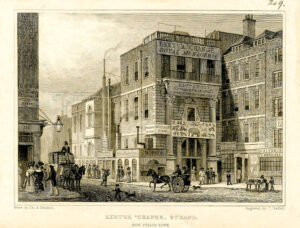
Exeter Change in the Strand. Thomas Hosmer Shepherd / Thomas Barber 1829. British Museum.
Above is the 1828 drawing. If you enlarge it, or find it online at the London Overlooked post which I have cited, you will see the magnificent elephant poster quite clearly!

2 comments
Wow! I love all this research and context, Diana! The idea of elephants played a small but important part of my S&S variation, but I didn’t know all that you shared here before writing that scene. I wish I had! Thanks for all your sleuthing, and I would love it if, someday, someone found that letter from Jane to Cassandra! 🙂
<3