
Thanks for joining me on our Create Your Own JAFF Adventure! Just starting? You can catch up on previous posts collected here: https://austenvariations.com/category/sarah-courtney/ .
Feeling a little lost? (I know it’s been a while since my last post.) You can read a summary of what has happened so far in the story here: quick summary.
Last post, the Bingleys and Hursts had just arrived for dinner, and Miss Bingley immediately approached Elizabeth with one of her sly digs. Elizabeth had the choice to respond with a snarkier comment reminding Miss Bingley of her family’s trade background, or to take the high road and simply get Miss Bingley’s goat by pointing out politely that Mr. Darcy was spending a good deal of time at the Gardiners’. You all voted for the latter, so we’ll begin with Elizabeth’s response.
If you’d prefer the third person version, you can read it here. There’s a link at the bottom of the intro part that will jump you to the newest part. Just don’t forget to come back and comment to tell me what Elizabeth should do next!

“Lady Matlock was very kind to take Miss Darcy into her house. I suppose that leaves Mr. Darcy here alone most days, except of course when his cousin can be spared from the barracks.”
Miss Bingley’s mouth tightens subtly at this reminder that Mr. Darcy is spending his days at the Gardiners with you, but she says nothing else.
Thankfully, you and Miss Bingley are not seated very close to each other at dinner, so Miss Bingley has no opportunity to recover and come back with her own subtle barbs thrown in your direction. You are instead forced to make polite conversation with Mr. Hurst, although Uncle’s presence on your other side gives you some minor relief.
After dinner, the women withdraw, although Mrs. Hurst makes some excuse about needing a retiring room for a moment to refresh herself, thus leaving you with Aunt Gardiner and Miss Bingley.
“I suppose you have never heard Miss Darcy play on the pianoforte,” Miss Bingley says at once. “Oh, what delights, what rapture! I have never heard any young lady who so perfectly combines taste and talent, beauty and art. Do you have an instrument here?” From her tone, she clearly expects a no, so you are delighted to point out that the Gardiners do indeed have such an instrument, as Aunt Gardiner plays and your cousins are learning.
Miss Bingley raises her eyebrows to hear her assumptions overturned. “I am glad to hear it,” she says. “I believe that every young woman should devote time to ensuring she can perform well. A home lacking in music is a sad place indeed. Of course, not many young ladies spend as many hours at their instrument as Miss Darcy! She is an example indeed, although of course, to her dedication she adds her own natural talents and taste.”
Perhaps she has excellent taste in music, but her taste in men is dubious.
“She is fond of the instrument, then?” Mrs. Gardiner asks.
“I have rarely heard better, and I have had the privilege of hearing many talented young ladies play, due to my position in society. Miss Darcy brings a rare feeling to the pianoforte that is exquisite.”
You cannot help but feel that Miss Bingley had better save her compliments for Miss Darcy for when Mr. Darcy is in the room, if that is her goal. Unless she is practicing her phrasing on you and your aunt first before trying them on Mr. Darcy.
When Mrs. Hurst returns and hears her sister peaking of Miss Darcy, she adds her own words of praise, and the panegyric to the young lady’s perfections continues until Uncle Gardiner, Mr. Darcy, and Mr. Bingley join you at last.
Miss Bingley calls out to Mr. Darcy as he enters, “We were just speaking of how well Miss Darcy plays, Mr. Darcy. You must be proud. Your influence over her has been tremendously beneficial, sir. I congratulate you.”
Mr. Darcy honours her with half a smile before returning his attention to Uncle Gardiner. Mr. Bingley takes a seat near the older couple, greeting Aunt Gardiner with his brilliant smile and a compliment about her dinner.
“A more doting older brother you will never find,” Miss Bingley says, her eyes roaming the room until they happen upon you again. “A pity, Miss Eliza, that you did not have the benefit of a brother. Doubly so, as I believe Longbourn is entailed on a distant cousin?”
She will have to try harder to hurt you than by mentioning the entailment. It has been a fact of life since you were old enough to understand Mamma’s wails. “It is.”
“I believe I saw you dancing with Mr. Collins at the ball at Netherfield Park.” Miss Bingley titters. “What a lovely performance the two of you made. I think I heard your mother say that there was an . . . understanding?”
“I am afraid you are mistaken.”
Miss Bingley’s eyes gleam. “It seems your mother was mistaken about several matches she crowed about during the ball.”
With great effort, you hold your tongue, but you cannot help glancing toward Mr. Bingley’s chair to ascertain if he heard Miss Bingley’s jibe. He is no longer there, and a quick glance around the room reveals his absence. When you look back at Miss Bingley, the woman seems to understand exactly who you were looking for, as her face is filled with triumph.
“I believe it is a common affliction among mothers,” Mr. Darcy says unexpectedly, and you both turn slightly toward him. “My own aunt, Lady Catherine de Bourgh, is fond of speaking of the match she is determined will happen between myself and my cousin Anne, even though neither Anne nor I have any intention of fulfilling her wishes. My other aunt has my cousin Arthur as good as married to any pretty girl with good connections or fortune whom he might dance with at a ball, so eager is she for grandchildren. All mothers seem eager for their offspring to wed so that they may have grandchildren to spoil.”
His eyes meet yours, humour dancing in them. He is rescuing you! You might prefer that he not speak of your mother’s foolish matchmaking, but it is true that Mamma has spoken far too freely of Mr. Bingley and Jane before the gentleman has proposed, so perhaps this is the best defence he might offer.
Movement at the door interrupts conversation as Mr. Bingley and Mr. Hurst appears in the doorway.
“It seems we forgot Mr. Hurst in the dining room,” Mr. Bingley says with a laugh. “Found him asleep in his chair while the servants cleared around him.”
It fits with what you have seen of Mr. Hurst during your days at Netherfield during Jane’s illness. But it does not explain Mr. Bingley’s own absence or why he thought to look back in the dining room when he discovered Mr. Hurst missing.
Are you just being paranoid? A quick glance at Mr. Darcy shows narrowed eyes and a tight mouth. He, too, is suspicious, but he says nothing.
Mr. Bingley takes the seat nearest Aunt and Uncle Gardiner and charms them by asking in great detail about Jane, the time she spends in London, and what she was like as a child. Mr. Hurst shows little shame over his nap in the dining room, choosing a comfortable seat near the fire and pretending to join the conversation, although his head nods. Mrs. Hurst moves closer to Miss Bingley, Mr. Darcy, and you.
“May I enquire how long you intend to stay in London?” you ask Mrs. Hurst politely. “I understand Mr. Bingley had business here for a few days?”
“Oh, once we are fixed in London we never want to leave it,” Miss Bingley answers for her sister. “And we are delighted to find Miss Darcy here. We have been desolate in the country without her. I for one will never forgive Mr. Darcy for coming to Netherfield Park without our dear friend.” She pouts, shaking her head.
“I wonder that your brother took a lease on an estate.” You frown. “A landed gentleman, you know, must spend part of the year on his estate if he is to fulfill his responsibilities.”
“Your father, I believe, spends all of the year on his!” Miss Bingley says brightly.
Mr. Darcy says, “I spend at least half the year at Pemberley. I could not call myself an active landowner if I did not. But it is different for Bingley with a leased estate, although I would have thought he would stay for at least a few more weeks of hunting before Christmas.”
“Hunting?” Mr. Hurst turns round at last, shifting on his couch. “Still a few more weeks of grouse shooting, to say nothing of the wild ducks and rabbit. Pity, that. Good gamekeeper at Netherfield Park, eh?”
Mr. Bingley, catching the last of their conversation, reddens a little. “I did intend to stay longer. That is, I only came to London for a few days’ business. But with Darcy’s accident and everything else, it did not seem right to hare off to Netherfield and leave him injured and alone in London.”
“I believe you may safely return to your grouse and pheasant if you wish to catch the end of the season,” Mr. Darcy says stiffly. “I am on the mend and should be able to return to Darcy House soon.”
“Oh, that is the best of news!” Miss Bingley claps. “We have felt for you, trapped here in . . .” She lets her sentence trail off, looking meaningfully at Elizabeth, before continuing. “Trapped here away from your own home and comforts. What a delight it will be to return to the elegant and peaceful Darcy House.”
“Yes,” Mr. Darcy murmurs, but it is your eye he catches. There is something warm in his gaze. “I will be pleased when I am recovered enough to remove to my home. Nevertheless, my time here has been comfortable indeed. The Gardiners are charming hosts. I have been happy here.” His eyes are still intent on yours, and you cannot turn away. He is happy here? He, who refused to dance at an assembly in Meryton because it was too rustic, he is happy here in Gracechurch Street near Cheapside, in view of your uncle’s warehouses?
Thankfully, the Bingleys do not stay long. You go up to bed soon after, finding yourself weary from withstanding Miss Bingley’s barbs. Oh, if only Jane were here! But no, if Jane were here, she would likely be lost in conversation with Mr. Bingley and entirely ignorant of Miss Bingley’s conversation at all.
As you stare up at the ceiling, you contemplate Mr. Darcy’s words about returning soon to Darcy House. It is true that he is recovering well. He has not complained of headaches for some time, nor has he grown pale and leaned on the doorframe this evening as he sometimes had previously. Another day or two and he might be gone.
Will you see him again once he has removed to his own home? Will the distance between Gracechurch Street and Mayfair prove too great?
Startling awake, you stare up at the ceiling for a moment. What has awakened you? The room is grey with early morning light, the fire already lit by the scullery maid, but nobody has yet come to wake you.
Then you hear an agitated voice from the passage, followed by a low rumble that you think might be your uncle. What is going on?
After hastily throwing on your dressing gown, you crack your door open and peer into the passage. A footman is hurrying toward the front door, and your uncle stands watching him leave. He turns at last and sees you.
“Ah, Lizzy. I suppose you heard the commotion?”
“What is going on?”
“It seems Mr. Darcy took a turn for the worse during the night. When his man Haverson could not wake him this morning, he sent for me at once. He was hesitant to take extreme measures to wake him, so I was the lucky man appointed to the task. He cannot throw me out of my own house for shaking him awake.”
“Shaking him! With his head injury?” You are aghast.
“No, no, I tease. I did not shake him, but I did call him rather loudly and then pulled him upright and splashed water on his face.”
“And?”
“To no avail. His breathing, too, is shallow and irregular as if he struggles for breath.” Uncle Gardiner’s face grows grave. “I have sent for Mr. Bartley.”
There is nothing for you to do but to dress and wait. You go down for breakfast at the usual time, but you cannot eat. It is a grim breakfast, as you and Aunt Gardiner eat silently, waiting for news from above.
Movement at the door relieves your anxiety at last, and you both leap to your feet as Uncle Gardiner enters.
“He is awake,” says Uncle Gardiner. “Well, mostly awake,” he then amends himself. “Mr. Bartley was able to rouse him and give him a sip of water, which he took, but he drifted back into unconsciousness several times before we could get him to stay awake. His breathing is rather shallow and grows alarmingly so when he sleeps, so the physician believes it better to keep him awake as much as possible. Haverson has taken on the task of giving him sips of water and tea and keeping him from drifting off.”
“What happened?” Aunt Gardiner asks.
“He has been almost better!” you cry. “He spoke of returning to Darcy House.”
“Mr. Bartley says that sometimes these things happen. He suspects the injury to his brain may have gone deeper than he initially supposed. But it is a good sign that we were able to wake him. Haverson has taken on the task of keeping his master awake and encouraging him to eat and drink.”
You frown. This explanation is ridiculous. Mr. Darcy was almost recovered. He has been talking and walking, his headache improved.
Colonel Fitzwilliam is sent for, and he arrives around noon and spends some hours with his cousin, saying that he and his mother think it best not to bring Miss Darcy at the present time. Unless Mr. Darcy takes a turn for the worse, he does not say, but the implication is visible in the tightness of the colonel’s mouth.
You feel as if you are not fully awake either. You take the children to the park with Miss Hammerlin while he visits with his cousin and return to stare blankly out the window, but your thoughts are always on the man upstairs and his condition.
The afternoon is growing late when there is a voice outside the parlour, and you leap to your feet as Mr. Darcy walks slowly in, Colonel Fitzwilliam close behind.
“Mr. Darcy!” you exclaim. “I am so pleased to see you well enough to come downstairs!”
“I could not bear to stay in that room any longer if I was not to be allowed to sleep,” Mr. Darcy says wryly. “I convinced the physician’s assistant here that I would do all the better for sitting up in a bright parlour.” He looks pointedly at the colonel.
“I see you have been promoted, colonel. Or would that be a demotion?”
“Regardless, it is a title I will willingly take on,” Colonel Fitzwilliam says. “I did not wish him to stumble into a wall and bash his brains out a second time on his way downstairs. His skull may be harder than rock, but there are only so many poundings it can take.”
“I admit to a little dizziness,” Mr. Darcy says. “Otherwise I feel much improved.”
Aunt Gardiner, who was upstairs with her children, comes down then, congratulating Mr. Darcy on his recovery.
You smile politely as the conversation flows around you, but you grow sober as you examine Mr. Darcy. He might be well enough to sit in a parlour, but there is still something odd about him. After a few minutes’ consideration, you realize he is breathing quickly and irregularly, as if he cannot get enough air. Is that the breathing that Mr. Bartley is concerned about? When Mr. Darcy smiles at you after his cousin makes a joke, his eyes look a bit odd. His pupils are pinpoints, as if he looks into bright sunlight—but his back is to the windows.
What does he remind you of? And why is it Lydia?
Hiding your smile at the thought, you turn your attention to the conversation, or try to. But the odd thought keeps coming back to you. Why do his symptoms make you think of Lydia?
Oh! Of course! He reminds you of the time when Lydia broke her arm. The poor girl was overwrought with the pain, and Mr. Jones dosed her with laudanum for the pain—far too much, given that she was a girl of thirteen and so slender and light at the time. She slept for a day and struggled to breathe when she awakened. Her pupils looked then just like Mr. Darcy’s do now.
Cold, icy fingers snatch at your throat, and you cough.
“Miss Bennet, are you well?” Mr. Darcy asks.
You nod. “Very well, I assure you.” But you are not. Your body is chilled despite the warm fire and happy company.
Mr. Darcy’s symptoms are supposedly from his original head injury. But he has relapsed after days of recovery for no reason—he has not fallen or hit his head again. And his symptoms match those of someone who has been given too much laudanum.
Has Mr. Darcy been taking laudanum for the pain? It is possible, you suppose. You could ask him.
But when you cast a glance in his direction, you see that he is now slumped slightly forward, resting his chin against his hand in a position very unlike his usual straight posture, and his eyes are half mast. Colonel Fitzwilliam says something to him, and he nods and straightens a little, his eyes opening, but it is clear that he is keeping himself awake with great effort.
You are not sure he can give you a sensible answer and be certain of it at the moment. You will have to wait to ask later.
If Mr. Darcy has taken laudanum, you do not think he did so willingly. Why would he, when he is on the path to recovery? The signs of laudanum were not present the night before, during the dinner with the Bingleys, so he has not been taking it regularly.
The Bingleys! Mr. Darcy has been suspicious of the family from the start, and he was injured on their property. Is he right to distrust them? Has one of them dosed him somehow? They were all there at dinner, and, in fact, almost all of them had been away from the group at some point during the evening. Any one of them, except perhaps for Miss Bingley, could have done it.
It is galling to release Miss Bingley from suspicion—unless she has been deliberately antagonising you in order to distract you from noticing the movements of the others?
You cannot accuse any of them without proof. And there may not be proof to be had.
But there is something you can do, at least.
When the party separates to dress for dinner, you hurry to your aunt’s medicine closet, hurriedly pushing bottles aside in your search for one in particular.
“Ah ha!” a small voice pipes up from behind you, and you feel the poke of a wooden implement in your back. “Surrender, thief!”
You put your hands up and turn to grin at Andrew, who is wearing one of his father’s old hats and brandishing a wooden sword. For once, there is no Michael behind him. He must be taking his afternoon nap.
“I am no thief!” you say. “Can you not recognize the ship’s apothecary checking her stores?”
Andrew sighs. “That is dull. Unless they are poisons?”
“Some of them may be if used incautiously, which is why you should never, never touch anything here without permission.”
“I know that.” Andrew rolls his eyes. “Mamma would whip me good. But what are you really doing?”
“I wanted to see if there was a bottle of laudanum here. I am not certain if Mr. Bartley has taken it for Mr. Darcy’s use.”
“I can check Mr. Darcy’s room for you!” Andrew says brightly. “Mamma has not let me in there even once since he came, and we used to play hide and seek under the bed and behind the curtains. Hide and seek has been very dull since we are confined to the nursery for hiding places. I will sneak in while Mr. Darcy is down at dinner.”
Andrew is a clever little boy. And if he is caught, nobody will think much of him sneaking into his old hiding place when it is temporarily unoccupied. Is it fair to ask him, though?
How else can you look for the bottle?
Molly! The maid who went out with Miss Darcy is friendly and obliging. She cleans Mr. Darcy’s rooms, so it would be natural for her to look for a bottle. It is too late today, but you can ask her to check tomorrow when she cleans the room. Will it be too late by then?
And if you ask her, will she tell Aunt Gardiner? Aunt Gardiner is an intelligent woman, but will she really be willing to believe the possibility that one of the Bingley party poisoned Mr. Darcy? She might be displeased with you for even considering such a notion, as she is not privy to Mr. Darcy’s confidences about his attack and suspicions, and you do not dare tell all of Mr. Darcy’s affair even to your beloved aunt.
You could also speak directly to Mr. Darcy. He is struggling to stay awake and follow conversation this afternoon, so it might be better to speak to him tomorrow about it. The longer you wait, the more chance that any evidence may be discarded. But if you speak to him about it today, what can he do? He is too dizzy to be useful or reliable in a search, and he might ask Colonel Fitzwilliam to help, which means sharing your perhaps foolish suspicions more publicly than you would wish it.
Whom should you ask to search for the bottle? Should you . . .
ask your cousin, Andrew, to make a spying game of searching for the bottle during dinner,
ask the maid, Molly, to search the room tomorrow while cleaning,
or catch Mr. Darcy on the way to dinner and tell him of your suspicions?
Let me know which option you vote for below! You get three choices this time!
I’ve always loved reading Summer Hanford’s bloopers that she posts on Facebook, but alas, my typos are usually of a more boring type. Lots of “hte” instead of “the” and “Bingely” instead of “Bingley.” However, I actually had a fun little typo for this part!
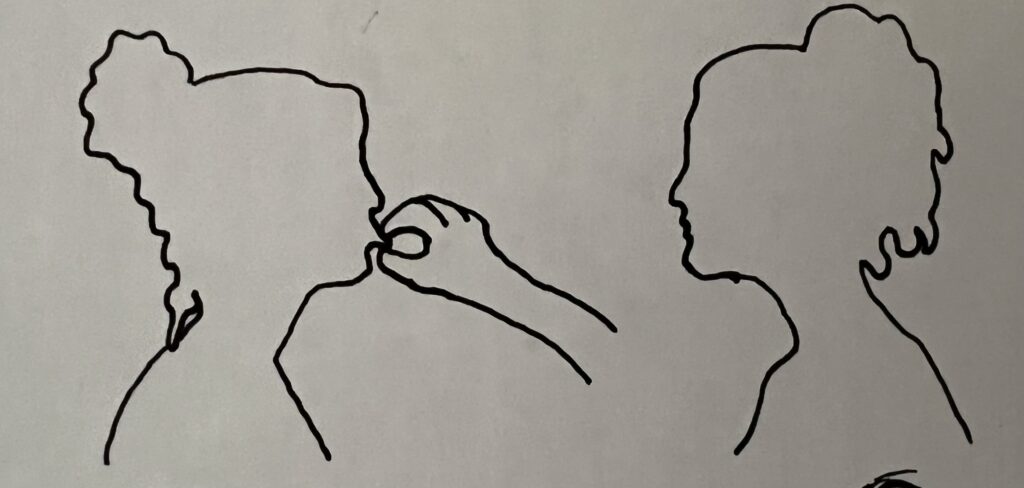
I write this story in third person past tense (preferred by my beta reader) and then convert it to second person present so that readers can take their pick. In the process of writing about Elizabeth keeping her temper at Miss Bingley’s barbs, I had “she held her tongue” and was changing it to “you hold your tongue.” Of course, I managed to forget a word, and ended up with “you hold her tongue.” Now wouldn’t that be a novel way for Elizabeth to stop Miss Bingley’s subtle digs! I illustrated it below for fun (you can see why I would never make it as an illustrator).

34 comments
Skip to comment form
Ask Andrew to look for the bottle
Tell Mr Darcy her thoughts
Catch Mr. Darcy on the way to dinner. Thanks for the summary.
Find Mr Darcy!
Tell Mr. Darcy and Col Fitzwilliam-who can help protect Darcy.
Have Elizabeth make up a spying game and ask Andrew to check Darcy’s room as part of the game.
Andrew!
I love your illustration. 🙂
I am for Elizabeth going to the source and speaking to Mr. Darcy if possible. Finding the bottle will not explain whether Mr. Darcy was dosed or by whom.
Another thought strikes me–Mr. Hurst is known for indulging himself with frequent naps but falling asleep during the time the ladies and gentlemen are separated after dinner seems odd. However, had laudanum been sloppily introduced to the after-dinner port during the separation of the sexes following dinner, it’s possible he (Mr. Hurst) might inadvertently ingested some.
You should talk to Mr. Darcy directly!
Elizabeth ought to tell Mr. Darcy himself, tonight, so that precautions can be taken in case the poisoner makes another attempt.
However, it is very tempting to also let Andrew go pretend to play and check for the bottle in the room, as well.
She should definitely tell Mr Darcy and he can decide whether to tell the Colonel!
I definitely think it was either Bingley or one of the Hursts who did it and Caroline was the distraction!
They should get the butler to refuse their visits in future.
Ask me daecy
I think ask Andrew, however I do feel Darcy and or Col Fitzwilliam should know. Col probably has an hunch already….
Ask cousin Andrew
Something is seriously wrong. Time is of the essence. Ask cousin Andrew to search the room.
I would not trust Molly even if she is trustworthy since she could accidentally tell the other servants and who’s to say one of them isn’t somehow related to the Bingleys?
Andrew is probably the best bet out of the three.
I’d ask Andrew. We could make a fun game of finding the bottle and nobody would be suspicious of a little boy.
I would try to speak to Mr Darcy.
Ask Andrew. Molly may not be trustworthy and Darcy is under the influence of the laudanum and can’t think clearly.
This is a difficult choice! I think tell Darcy and enlist the Colonel’s help even if you prove foolish in the end.
Send Andrew! Sounds like more fun.
Darcy has been fairly honest with Lizzy, so I think she should be honest with him. She can explain about Lydia and the morphine arousing her suspicions and take it from there. Asking if he accidently took an extra dose would be a way of saying something without directly accusing, or assuming Bingley involvement. Joining the dots can follow………! But she could also start by giving Andrew the chance to play detective. I think he’d enjoy that.
I definitely like the idea of involving Darcy directly.
Tell Darcy
Bingley was acting very suspiciously! I think Elizabeth should tell Andrew to play a spying game and also talk to Mr. Darcy about the issue. It’s probably a good idea to get the Colonel involved, also. Unless we have some concerns that he’s not the good friend/cousin that we’re assuming he is…
I love your typo and illustration!
I would catch Mr. Darcy on the way to dinner and tell him of my suspicions; best to act promptly if someone is poisoning him.
I vote to go straight to the source and talk to Darcy. Getting the Colonel involved would also be excellent as Darcy has expressed he trusts him.
That was a great typo! My favorite mistake is if typing ‘does not’ too quickly and you misplace the space, you get ‘doe snot’. 🤭
I tell Mr. Darcy about my suspicions. He, apparently, is also suspicious of the Bingleys. If I cannot get a coherent answer from him, then I send Andrew to spy for me.
Catch Mr. Darcy on the way to dinner and tell him of your suspicions
Catch Darcy.
I think you could get more information out of Andrew or Mr Darcy. Can you do both?
Best she ask Darcy directly. We know too well her frankness to expect anything otherwise.
Author
Thank you for voting, everyone! The choice ended up being to tell Mr. Darcy. But don’t worry! Andrew has his part to play yet. I can’t wait to share the next part with you.
Talk to Mr. Darcy, even drugged he will be sharp enough for the conversation.