
I have always had a fondness for the less-travelled road, and earlier this year the less-travelled road took me and my husband to the coast of Norfolk. It was our first trip to East Anglia. I can’t imagine why we had never visited that part of the country before (but I’m pretty sure that if it had a strong connection with Jane Austen, I would have rushed to visit much sooner).
I imagine she never had cause to travel all the way across Norfolk to the delightfully named Cley Next the Sea, with its beautiful Flemish gables and Georgian façades, and its iconic 18th century windmill.
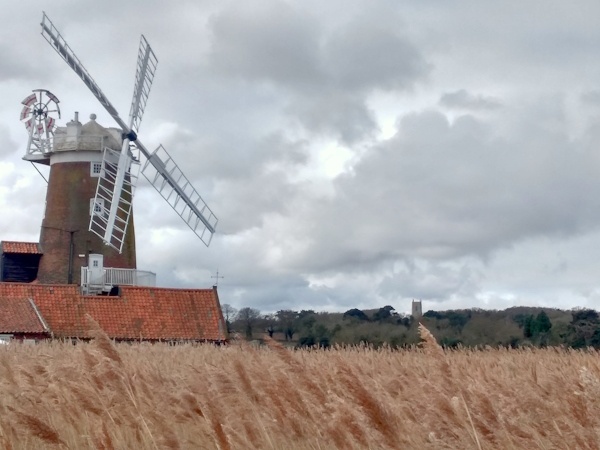
(Windmill, Cley Next the Sea. Photo © Joana Starnes)
Nor are there any links between her and Felbrigg or Blickling Hall.


Even so, I found glimpses of Pemberley in both, and the library at Blickling Hall is exquisite. It contains over 12500 books (the largest book collection cared for by the National Trust). I’d volunteer in the library in a heartbeat if I lived nearby (and if they’d have me).
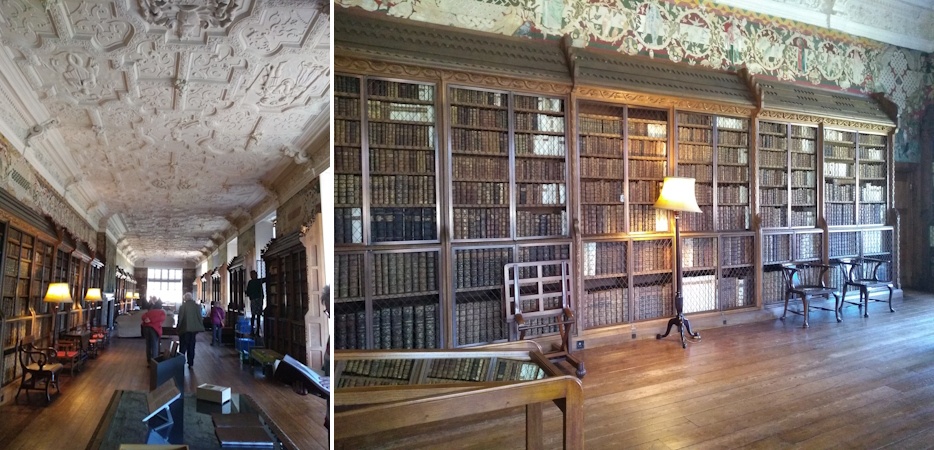
The library, Blickling Hall. Photos © Joana Starnes
There are many more stately homes in the east of England (some of the most notable are listed here: www.visiteastofengland.com/post/visit-top-stately-homes-in-the-east-of-england ). Sadly, we were in the area just for five days, and we could not visit them all. But I could not go home without stopping in Lavenham.
There is something quite magical about this beautiful village and its history – not least the fact that, despite all odds, it survived to the present day, and is now known as one of the best-kept medieval villages in the UK.
The manor of Lavenham predates the Norman Conquest. The Lavenham Market and the yearly fair were established by royal charter as far back as 1257. But Lavenham’s meteoric rise in fortune occurred a couple of hundred years later. It was due to a boom period in the wool trade during the second half of the 15th century and the first few decades of the 16th century. In 1524, Lavenham was the 14th wealthiest town in England. This vast accumulation of wealth led to a flourishing community and the swift construction of most of the timber-framed buildings we see in Lavenham today.
-
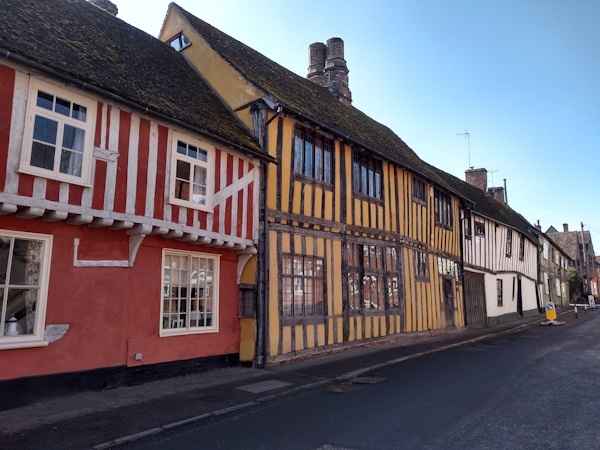
- Water Street, Lavenham. Photo © Joana Starnes
-
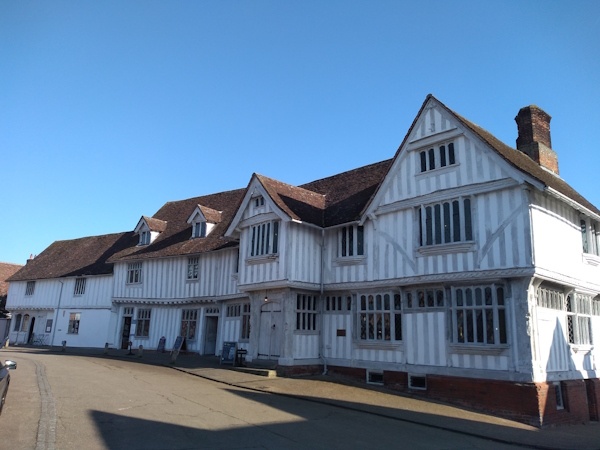
- The Guildhall, Lavenham. Photo © Joana Starnes
-
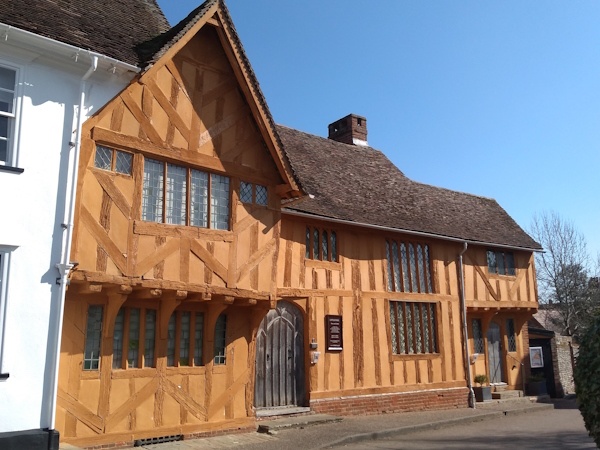
- The Little Hall, Lavenham. Photo © Joana Starnes
-
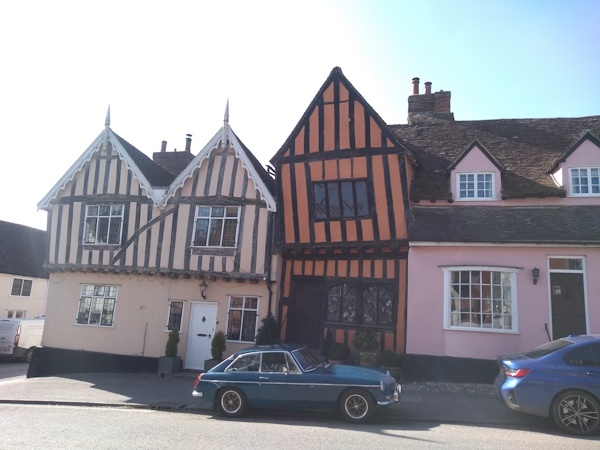
- The Crooked House, Lavenham. Photo © Joana Starnes
But the town’s fortunes were reversed just as dramatically. In the latter part of the 16th century, the woolen broadcloth produced in Lavenham was no longer in high demand. Many of the export markets were lost due to the international climate. Dutch refugees settled in Colchester and brought with them new techniques that led to the production of a lighter, cheaper and more fashionable type of cloth. Italian clothiers introduced finer merchandise such as silks and cottons. By the end of the century, Lavenham lost its reputation as a major trading town. Thus, its inhabitants were left without the means to modernise the timber-framed buildings and replace them with ones designed and built after the latest fashion.
Slow decline followed and endured for the best part of two hundred years. Many of the large timber-framed buildings – once the prized possessions of wealthy merchants – were divided into small homes for impoverished families. The Guildhall of Corpus Christi became a workhouse, having already served as a bridewell (house of correction) for a long while.
The threat of mass demolition was kept at bay by the arrival of the railway, which brought a period of revival, but by the early 1900s most of the timber-framed buildings had been declared unsafe and unfit for habitation. Perhaps a great many of them would have been pulled down, were it not for the determined efforts of Francis Lingard Ranson and the other founders of the Lavenham Preservation Committee. After years of trying, they finally succeeded in obtaining national recognition for the architectural and historical importance of their beloved village.
I’ll post some more photos on Facebook, both from Lavenham and Norfolk and from the few days in Rome with my daughter, earlier this month. I wrote a little about that on my website the other day (A Tiny Taste of the Grand Tour), but there’s still plenty of room for speculation. What if Mr Bennet met Mr Darcy’s father on their Grand Tour when they were young? What if that encounter led to a lasting friendship? Did Mr Darcy get the chance to travel on the Continent before he came of age? Did Colonel Fitzwilliam travel with him and maybe rescued him from scrapes, or was Mr Darcy’s favourite cousin chiefly responsible for getting him into trouble?
I can’t help thinking that the ancient ruins of the Palatine Hill and Forum Romanum must have held great interest for the young men who had not travelled across the Continent merely to enjoy themselves, drink, gamble and sow their wild oats. Studying the ancient Latin and Greek literature, philosophy and history formed the largest part of a young gentleman’s education. Having travelled hundreds of miles to get there, it must have been quite an experience to finally lay eyes on scenes and monuments previously seen only in sketches and engravings.
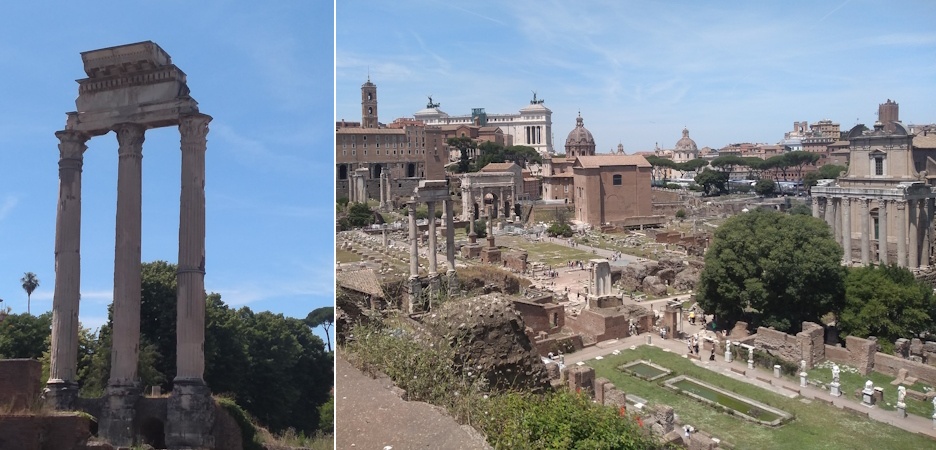
Left: Temple of Castor and Pollux; Right: Forum Romanum. Photos © Joana Starnes
Thanks for travelling with me today. All the best and see you again soon.
* * * * * * * * * * * * * * * * * * * *
Photos © Joana Starnes
Sources:
National Trust – Lavenham Guildhall guidebook 2018 (reprinted 2022, 2024)
Online Sources:
https://www.visiteastofengland.com/post/visit-top-stately-homes-in-the-east-of-england
https://unlockingthearchive.co.uk/blickling-estate/
https://www.nationaltrust.org.uk/discover/history/art-collections/great-books-in-our-collections
https://www.nationaltrust.org.uk/visit/suffolk/lavenham-guildhall/history-of-lavenham-village
https://www.nationaltrust.org.uk/visit/suffolk/lavenham-guildhall/history-of-lavenham-guildhall
https://www.lovelavenham.co.uk/history-lavenham/

17 comments
Skip to comment form
Gorgeous and fascinating pictures of the old English village. I could spend days going around there if it were possible!!
Author
That’s what I thought too, Teresa. I could spend days going around there. A few hours weren’t enough. It’s such a beautiful and amazing place! Thanks for reading, I’m so glad you liked the post.
I was desperate to see Blickling Hall, it being the birthplace of Anne Boleyn but once there discovered that the earlier house was long gone. I suppose geographically it’s the same spot but if only the older house had survived. Hever Castle has been so extensively renovated it doesn’t bear much resemblance to the place where Anne grew up but it still seems more evocative of Tudor times and Anne’s life. If only we could time travel and see how things really were!
Author
So true, Andrea. Geographically it’s the same spot, but it’s such a pity that the older house hadn’t survived. I know what you mean about time travel too. If only…
All the best and thanks for reading.
Interesting. Living in the USA and with limited resources, I will never visit those sites but it was interesting reading about them here. I do enjoy reading about the history of various sites. Even though ours are not as old as UK, we also have some interesting places here, i.e., Colonial Williamsburg, which is one I have visited. Plus, being near Philadelphia I have visited many buildings there, i.e., the Betsy Ross house and Independence Hall. We are expecting 100 degrees today!
Author
Oh my goodness, 100 degrees! Keep cool, dear Sheila, and stay safe!
Hello. I am a dedicated JAFF reader and have enjoyed many of your books. I too love Norfolk although the main A road is often so slow moving it can be a bit of problem. It is almost a place time forgot, it is often quite a walk to find a decent phone signal! Felbrigg is supposedly the coldest home in the national trust, and each time we have visited it certainly has been chilly and very windy. As a keen embroiderer I enjoyed a visit to the NT fabric conservation department at Blickling some years ago with my local embroidery group. I think it is at Blickling, tucked away behind a door is a small oil, of I think, Queen Ann of Bohemia, looking remarkably like our own Princess Ann the Princess Royal all dressed up for a fancy dress ball. Although it might be at any of the other NT houses we have visited , as I haven’t been able to find it again!
Do keep on entertaining us with your books. Best wishes Lois
Author
Thanks so much for this, Lois! I didn’t know that Felbrigg was supposed to be the coldest home in the National Trust. It was pretty chilly when we visited, but we went in March so I took it as read that it would be rather cold. That’s so wonderful, being able to visit the NT fabric conservation department at Blickling! I don’t think I’ve seen the small oil of Queen Ann of Bohemia, but I’ll keep an eye out for it if we visit again. I hope we do, it’s such a beautiful place! And I think the second-hand bookshop is definitely in the top 10 NT ones, if not the best. Just wonderful! Thanks for reading my posts and my books, and all the best!
What a lovely and thoughtful post, Joana! Can I also say it’s a pleasure to read good writing as well? Anyone who writes “young men who had not travelled” instead of “young men that didn’t travel” understands both personal pronouns and verb tense, and is a writer after my own heart. The photos only enhance your vivid descriptions of those gorgeous historic sites. Many thanks for giving this American a glimpse of your England.
Author
Thank *you*, Susan! You’re ever so kind! This made me so happy. Thank you!! Best wishes and many thanks ever so much for letting me know you like my books and my posts!
We went to Lavenham and we went to Blickling twice – once for Halloween (since it’s said to be haunted by Anne Boleyn and her father) as well as for the bluebells. They have first editions of several Jane Austen novels in the library as well as a reticule copy of one (I think S&S). Blickling is a lot of fun.
We visited Rome and went to Palatine Hill and the Forum as well. My younger daughter just got back from a study abroad and was able to return to Rome. She wasn’t as fond of it this time around, but different time of year and a lot more tourists to contend with than October when we went the first time. Glad you had an amazing holiday! Hugs!
Author
That’s so cool, going to Blickling for Halloween! Did you catch sight of Anne Boleyn and her father? The gardens must have looked so lovely when the bluebells were out. It was daffodils season when we went, and they were everywhere. I’m so glad you’ve got your daughter back. I think I know what she means about enjoying Rome more in October. My daughter went with a friend in February a couple of years ago and said it was a lot more relaxing. I’d love to see it again at a less busy time. Hugs right back, dear Leslie, and have a really good summer!
For some reason I’m unable to comment on this site using my iPad so have to use my phone! I love all your info and the wonderful photos, those buildings are amazing, especially the crooked house! Thank you for sharing 🥰
Author
The buildings are *so* amazing, aren’t they? I’ve seen a couple that were so tilted or twisted that I wondered how they still stood. Thanks for checking out the photos, dear Glynis! I’m so glad you liked them. Big hugs and all the best!
Thank you for this post. I enjoyed the photos and history. What a library!
Author
What a library indeed! Thanks, TC, I’m so glad you enjoyed the post!
Thank you for the visit! … visits!