
When I was writing The Slipper Scandal (which will be released into the wild tomorrow!) I wanted to think up some lesser used sites in 1811 London where ODC could meet. The story takes place in January/February of 1811 (yep, a little pre-canon), so these places needed to be indoors.
The main one I decided to use was Bullock’s Museum.
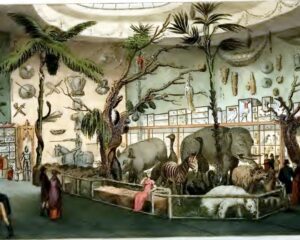
Bullock’s Museum, Picadilly, June 1810
In the early 19th century, London was captivated by ancient Egypt, a trend fueled by Napoleon’s Egyptian campaign and the subsequent publication of Description de l’Égypte (a series of publications that began in 1809). Amidst this cultural backdrop, William Bullock, a naturalist and antiquarian, sought to create a museum that would house his extensive collection of curiosities. The result was the Egyptian Hall, an architectural marvel that stood as a testament to the era’s Egyptomania.
Completed in 1812 at a cost of £16,000, the Egyptian Hall was designed by architect Peter Frederick Robinson. Its façade, inspired by the temples of ancient Egypt, featured massive columns and hieroglyphic inscriptions, making it one of the first buildings in England to adopt the Egyptian Revival style. Inside, visitors encountered a vast array of exhibits, from natural history specimens to ethnographic artifacts collected during Bullock’s travels and acquisitions.
The Egyptian Hall quickly became a hub for exhibitions that blended education with entertainment. In 1816, Bullock showcased a collection of Napoleonic relics, including the emperor’s carriage captured at Waterloo, drawing over 220,000 visitors and earning him £35,000. Later, in 1824, he presented the “Ancient Mexico” exhibition, featuring Aztec artifacts and codices, some of which were original pieces from Mexico City. These exhibitions not only satisfied public curiosity but also contributed to the broader dissemination of knowledge about distant cultures.
After Bullock sold his collection in 1819, the Egyptian Hall transitioned into a versatile exhibition space. It hosted art exhibitions, including works by J.M.W. Turner and the Society of Painters in Water Colours. The hall also became known for its theatrical performances and lectures. In the latter half of the 19th century, it earned the moniker “England’s Home of Mystery” due to the magic shows of Maskelyne and Cooke, who performed there for over 30 years.
Despite its popularity, the Egyptian Hall was demolished in 1905 to make way for modern developments. Today, the site at 170–173 Piccadilly bears little resemblance to its exotic predecessor. However, the Egyptian Hall’s legacy endures as a symbol of a time when Londoners were eager to explore the mysteries of the world through the lens of spectacle and science.
The story of William Bullock’s Egyptian Hall reminds us of the enduring human desire to understand and experience the unknown, a pursuit that continues to shape museums and exhibitions today.
From History to Fiction: The Slipper Scandal at Bullock’s
In The Slipper Scandal, Bullock’s Museum is still at the previous site in Picadilly. The Egyptian Hall had not yet been completed, and the collections were bursting at the seams.
It is here that Elizabeth suffered through an awkward meeting, where Elizabeth she is still feeling a bit like a bird captured in a cage, but is also beginning to discover an interest in her betrothed.
Here’s an excerpt from Chapter 10:
 Elizabeth laughed, then abruptly fell silent as they rounded a corner and came face to face with the centrepiece of the Cabinet Room: a massive crocodile suspended from the ceiling. It was preserved with remarkable skill, its scaled hide gleaming in the early morning light. The creature’s jaws were parted to reveal rows of fearsome teeth, and its glass eyes seemed to follow them with ancient, reptilian cunning.
“Good heavens,” Elizabeth murmured, unable to look away from the magnificent beast. “One almost expects it to snap its jaws shut.”
“I assure you, it shall remain quite still,” said a familiar voice from behind them.
Elizabeth turned, her heart giving an odd little leap as she found herself looking up into the face of Mr. Darcy. He stood a few paces away, as inscrutable as ever.
“I did not know you would be here, Mr. Darcy,” Arabella said.
“Mr. Grayson invited me, as I am Miss Bennet’s intended. Alas, he left the invitation rather late.”
“How lovely,” Arabella said.
“Mr. Darcy,” Elizabeth said, dropping into a neat curtsy. “What a pleasant surprise.”
It was not entirely a surprise, of course. London society, especially during the season, operated within a relatively small circle. One could reasonably expect to encounter the same faces at most events of note, and once the word of their engagement had made the rounds of the gossips, people would be throwing them together whenever possible. Still, she had not anticipated seeing him here, among the stuffed birds and ancient artifacts. She would not have thought it would be of interest to him.
“Miss Bennet. Miss Abernathy.” Mr. Darcy bowed to each in turn. “I trust you are enjoying the exhibition?”
Before either could respond, Colonel Fitzwilliam emerged from behind a giant rhinoceros, his countenance brightening considerably at the sight of Arabella. Elizabeth turned her head to watch Arabella’s reaction, and it was an excellent match for her suitor’s.
“Miss Abernathy! What a delightful coincidence,” he exclaimed, though Elizabeth somehow suspected it was no coincidence at all. “And Miss Bennet, of course. I had no idea you ladies had an interest in natural history.”
This final claim of innocence rang a little false, but Elizabeth could not blame him for it.
“I find all manner of curiosities fascinating,” Arabella replied, her earlier aggravation with Mr. Grayson seemingly forgotten as she smiled up at the colonel. “Though I confess, I am not entirely convinced this crocodile is a genuine article and not some clever fabrication.”
“I believe Mr. Bullock acquired it from a collector who brought it directly from Egypt,” Colonel Fitzwilliam said. “Though one can never be entirely certain, I suppose.”
“Its authenticity is well-documented,” Mr. Darcy interjected. “The species is Crocodylus niloticus—the Nile crocodile. They have long been known to grow to such impressive dimensions.”
Elizabeth studied him with renewed interest. “You are knowledgeable about reptiles, Mr. Darcy?”
A faint flush coloured his cheeks. “Not particularly. I merely read the exhibition catalogue before our arrival.”
“How sensible,” she replied, her tone light. “One should always be prepared to identify any Nile crocodiles one might encounter in London.”
For a moment, she feared she had overstepped, but then she caught the barest hint of amusement in his eyes.
“Indeed, Miss Bennet. Though I believe the Thames is rather too cold for them to flourish.”
Elizabeth smiled, surprised and pleased by this glimpse of humour. “A fortunate circumstance for London’s watermen.”
Colonel Fitzwilliam laughed outright. “I can see the broadsheets now: ‘Terror on the Thames! Exotic Beasts Devour Unfortunate Boatman!'”
“Do not give our showman Mr. Bullock any ideas of that sort,” Arabella reproved him teasingly.
“You are quite right, Miss Abernathy. I do apologise.” The colonel offered his arm. “Perhaps you might allow me to make amends by showing you some of the items from Captain Cook’s travels on the South Seas? The shells are remarkable. Quite unlike anything we have here.”
As Arabella accepted his arm with visible pleasure, Elizabeth found herself left alone with Mr. Darcy. She was suddenly, acutely aware of the narrow space between display cases, which forced them to stand rather close.
______________________________________________________________________________________________________________________
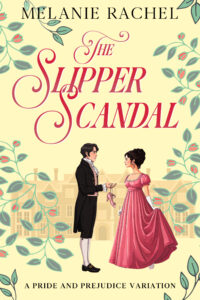
Want to know what happens next? Read The Slipper Scandal, out tomorrow and available in e-book, paperback, and Kindle Unlimited!
(I used Wikipedia, Londonist, and Arthur Lloyd as sources for this article)–MR

1 comment
Good luck with the release. I plan to borrow this through KU.