
This summer, I had the absolutely delightful opportunity to visit Bath and walk a little in Jane Austen’s footsteps. I posted a while ago about some of the different places I visited, including Jane’s father’s church and the cottage at Chawton, but I also really enjoyed touring a sample Georgian home while I was in Bath. This is at 1 Royal Crescent and is not to be missed if you visit Bath yourself!
The Georgian era spans over 100 years of British history during the time of the many king Georges! The Regency era, when George IV was prince regent during his father’s ailing years, is included in this time period. Some of the items in this house were a little before the time we often set Pride and Prejudice and Austen’s other books, like the harpsichord (instead of a pianoforte) in the drawing room. But the house is much like a house of a wealthy family would be during Jane Austen’s lifespan and I thought it gave great insight into what a house of that time would really feel like.
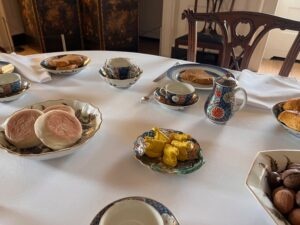
The first room you enter when you tour the house is the dining room. The table is set for breakfast, and I thought it interesting that, along with fruit and nuts, a lot of the breakfast foods are breads. Not breads that would need a lot of rising time, but breads nonetheless.
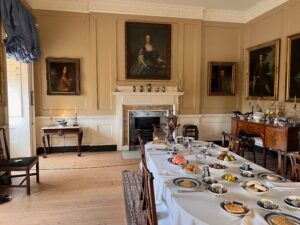
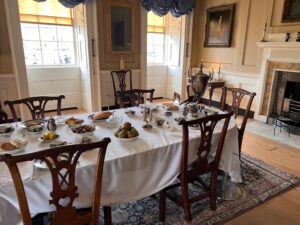
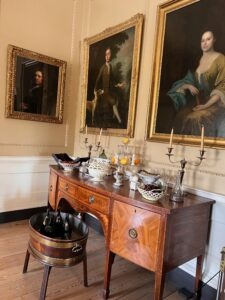
The sign for the room said that the English dined “á la française,” where all the dishes were placed on the table at once and everyone served themselves from the dishes that were closest. I’m not sure if that’s true for breakfast as well, but you can see that the breakfast foods also seem to have been placed on the table and not on the sideboard seen below.
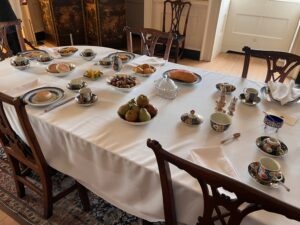
The little yellow cows? They are butter! Isn’t that an adorable way to serve it?
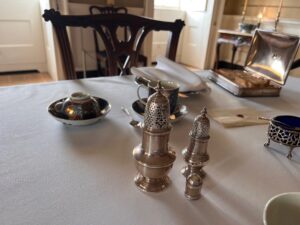
One of my favorite features was the little toaster. They would toast day-old bread in this little box that could be held over the fire.
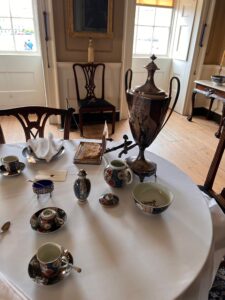
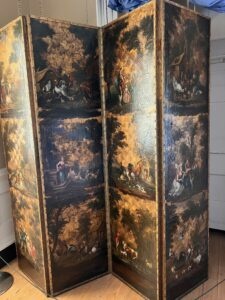
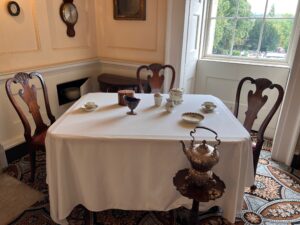
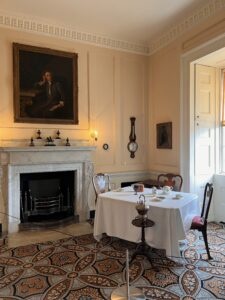
This next room is the family parlour, a room where the family could be comfortable and private. Close friends would also be invited into the parlour. The little table is set with tea things, although breakfast could also be taken in this room.
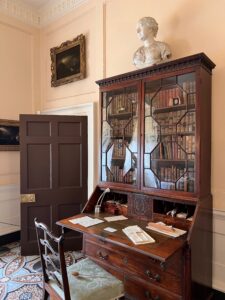
This parlour also held an elegant bureau bookcase where a gentleman could take care of business affairs and write letters. You’ll notice lots of books and newspapers, as this was an era for increasing interest in “ordinary” (although still gentry) people about affairs outside their homes and locality. Mr. Collins would also have enjoyed having this window on the crescent where he could watch people pass by and hope to catch sight of a noble.
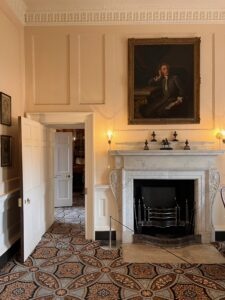
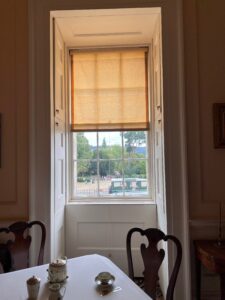
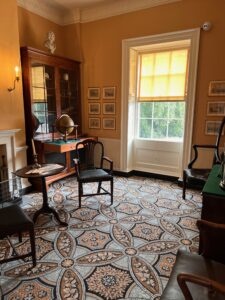
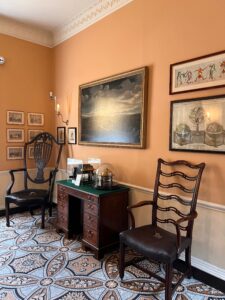
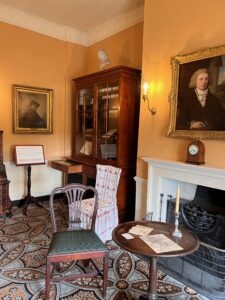
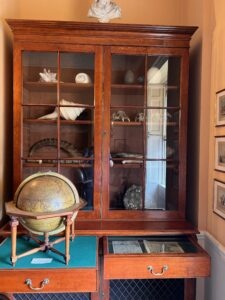
The next room to show you is the gentleman’s study. In this Enlightenment Era, wealthy gentlemen were increasingly interested in math, science, and geography, demonstrated by the globe and curiosities cabinet–much like the curiosities Mr. Knightley offered to Mr. Woodhouse to keep him entertained during the strawberry picking at Donwell Abbey!
An up close of the curiosities cabinet. I was particularly fascinated by this little machine! What is it? It’s a sort of “toy” that demonstrates electricity! It has a handle that you can spin, and it creates a spark. For what purpose? Absolutely nothing! They may not have invented the lightbulb or developed any of the ways we usually think of for using electricity, but they were on the cusp of so many inventions. At this point, electricity was more of an interesting curiosity than a tool, but its time was coming.
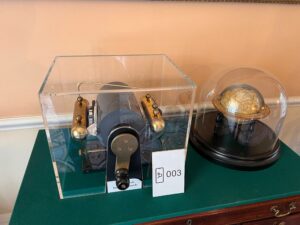
If you want to see the little device in action, click here to watch the short video! https://authorsarahcourtney.com/electricity You need to watch carefully just above the large gold-colored tube where a smaller tube branches up out of it. It’s just a quick spark!
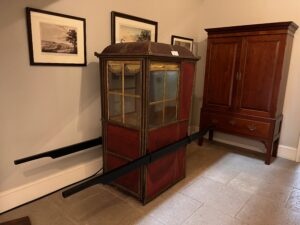
Bath is, of course, the place where people go who are feeling unwell, so it is fitting that we should see a sedan chair in a townhouse here. This was a mode of transportation for those who were feeling too ill or weak to get themselves to the baths and needed to be carried.
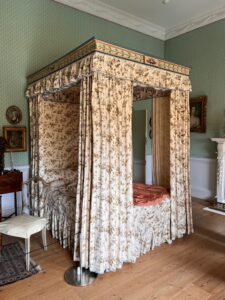
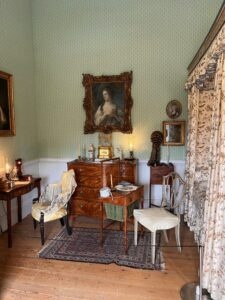
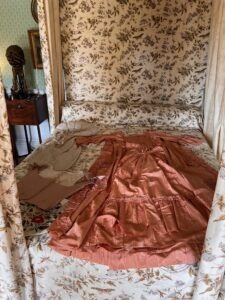
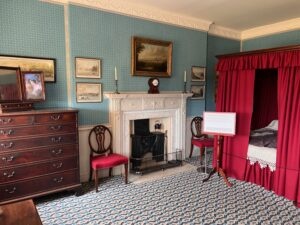
Our next room is the lady’s bedchamber. I know there’s a some disagreement in the JAFF world over whether couples in the Regency era (especially Elizabeth and Darcy) would have separate bedchambers or share one, and the answer is probably “it depends.” The sign in the gentleman’s room did say that “married couples in the Georgian upper class usually kept separate bedrooms.”
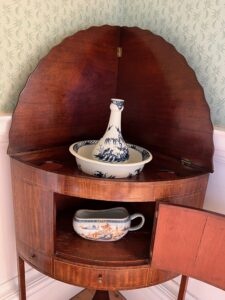
I love the little cupboard with the bourdaloue, a sort of handheld chamber pot that could be held under a dress.
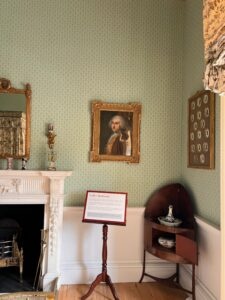
We also see the women, too, had their own little curiosities or interesting decorative items. This little birdcage is an ornament that had a little toy bird. I believe the audio for the room said that it was a mechanical toy that would play music.
A wig stands ready at her dressing table. While they weren’t wearing wigs as commonly by the time we usually set Jane Austen’s stories, they might have been more common in Bath due to it being frequented by those with health problems. And of course, wigs were much more common in the earlier Georgian times before the turn of the century.
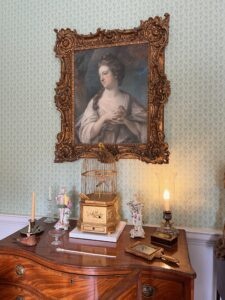
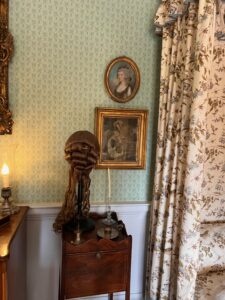
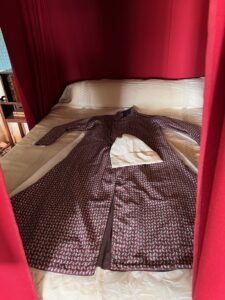
You can see that the lady of the house has her own writing desk here in her bedroom. Laid out on her bed is her dressing gown, ready for a good night’s sleep.
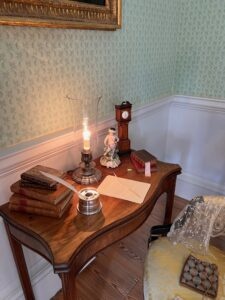
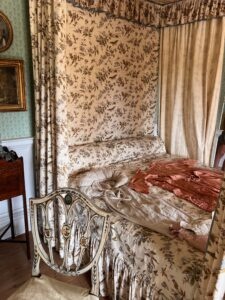
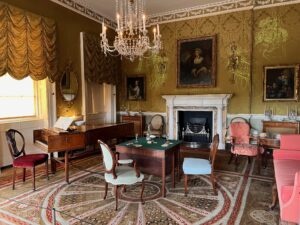
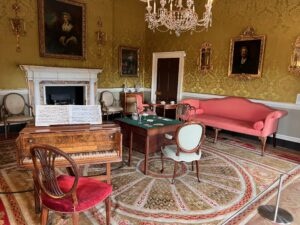
This was one of my favorite rooms, because I could absolutely picture the Darcys and the Bingleys sitting here after dinner, a few playing cards at the table, others sitting on the chairs and sofa or taking a turn about the room. Can’t you just imagine Caroline taking Elizabeth’s arm and circling the room with her, or Lucy Steele whispering cruel secrets to Eleanor Dashwood?
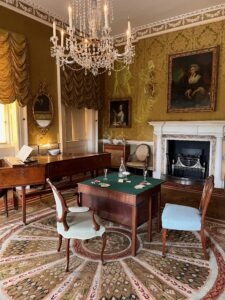
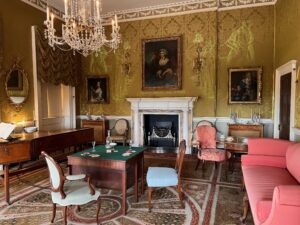
There’s a harpsichord rather than a pianoforte in this room, making it perhaps more fitting for the time of the elder Mr. Darcy and Lady Anne Darcy, but I like to imagine Georgiana Darcy sitting at the instrument anyway.
And now on to the gentleman’s bedroom! It’s a bit simpler than the lady’s room–possibly because he already has a study as well? But it gives him his own private space upstairs as well.
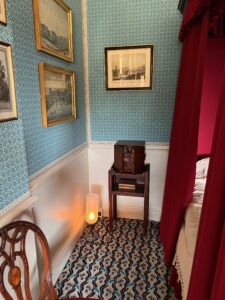
I believe this is a little toiletries cabinet?
We’ve seen the upstairs! But the gentry were not the only people who lived in one of these wealthy townhouses. They were often outnumbered by the servants who did all the work to keep the house running. In my next post, I’ll include pictures of the lower floor of a Georgian townhouse with the housekeeper’s room, the kitchen, and the scullery.

11 comments
Skip to comment form
Thank you for sharing.
My daughter took Mum and I to Bath 14 years ago but alas we didn’t get round to visiting this house! So thank you for all the photos and the commentary 🥰
So much fun! Thank you for posting this.
Thanks for sharing. These pictures are super interesting to all of us history nerds. 🙂
I was lucky enough to visit 1 Royal Crescent several years ago – it is fabulous. Thanks for the reminder of my fun visit there!
So fascinating!!! I will add this to my list of places to go. Appreciate the insight. I always wonder when reading Jane Austen or JAFF how so many people could be in a room and there still be private conversations as often alluded to? Always envision huge drawing rooms like the one shown at Pemberley in the Colin Firth BBC movie version, but that doesn’t seem accurate. Thanks so much for sharing!
The bird in the cage is called an automaton. In good working condition they are worth a LOT of money. They pop up now and again on Antiques Roadshow and I have always longed to own one. I can attest separate bedrooms are an excellent idea as everybody gets a good night’s sleep. If I were alive back then no doubt I would have slept in the servant’s quarters, up at 5 setting fires, and scrubbing pots all day.
Thank you for sharing
Thank you for sharing! Loved all the pictures and info.
Thank you! I was wondering about what the inside of the houses actually looked like, and you met my curiosity.
I noticed that some of the windows ate very deeply set in the walls. Were those hiding closets, servants’ passages or something else?
Thanks again,
Michael
Have visited this place a couple of times – happy memories.
Back to bath later this month to see Austentatious in the Theatre.
I love Bath…