
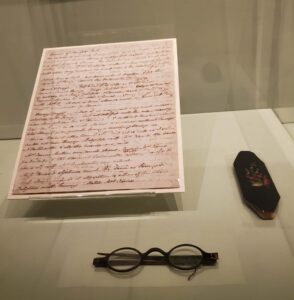
Jane Austen’s spectacles, and her collection of opinions of Mansfield Park
I spent most of December in England, celebrating a dowager’s milestone birthday (er, that is, mine!). It was not primarily a Jane Austen-centered trip; throughout my long lifetime I have most satisfyingly visited nearly every Austen-related site that I desired to see. (To confess the truth, I have not climbed Box Hill, but I may yet!) Still, I am not so much changed as to be able to spend time in England without seeing something relating to Jane, so I propose to make a few posts telling what I saw on this trip. (I’d have been less dilatory about it but I caught the travel illness that is often the tax for such a trip, and was down with bronchitis for most of January.)
A friend who is a librarian at the British Library (oh what a job!) invited me and the professor friend I was traveling with (you guessed it – a Jane Austen expert) to visit the Treasures of the British Library exhibit. Among the Treasures that we saw was a pair of Jane Austen’s spectacles, with their embroidered case, alongside Jane Austen’s handwritten collection of the opinions of her friends and family of Mansfield Park.
The spectacles had been kept inside Jane Austen’s portable writing desk, for generations. It was donated to the British Library by the author and JASNA co-founder Joan Austen-Leigh, Jane Austen’s great-great-great niece, in 1999, two years before her death. Handed down in the family from aunt to niece (I believe Joan received it from her aunt, the mystery novelist Lois Austen-Leigh), during Joan’s tenure, the desk and spectacles lived inside Joan’s bank vault.
As it happened, Joan and I were very good friends; we traveled together in England, and visited each other’s homes, and of course often met at JASNA AGMs. She showed me some of the family artifacts, and we talked endlessly about Austen’s books, the family, our adventures in England (once, on a visit to Alwyn Austen, I held in my hand Cassandra’s famous water color of Jane with her back turned!) and vented about publishing difficulties. Joan, who wrote her first novel in her late 50s, self-published, until St. Martin’s Press published her two Highbury novels, much to her delight, while I was working on my first book Mrs Darcy’s Dilemma, for which she kindly wrote the book cover blurb for the first edition. First published in 1997, this has recently had a third, digital publication by an English press, portrayed as a “classic” (I told you I was getting old!), and is still making me feel proud.
Although Joan briefly showed me the desk, and mentioned the glasses, I never actually saw them until this British Library exhibit, 25 years after her death. It was a poignant, moving moment as I stood before them and thought about my friend. Only one pair of the tortoise shell glasses was on display; optical experts have examined all three, and by their evidence Jane Austen was far-sighted and probably used her spectacles for close work such as reading, writing, or sewing. The first, wire pair, are weak in strength; the two tortoises are much stronger, and may indicate that her sight deteriorated in later life, though her handwriting (such as the alternate ending to Persuasion) never showed evidence of worsening.
Janine Barchas has written an interesting article, “Speculations on Spectacles,” https://www.journals.uchicago.edu/doi/full/10.1086/692020# investigating the glasses, in which I learned that Jane Austen’s mother also had a pair of tortoiseshell specs, now in the Lyme Regis Museum. These indicate that her eyesight remained fairly good all her relatively long life.
But mysteries remain. Jane Austen often mentioned having “weak eyes,” and the experts speculate that their deterioration may have been due to cataracts. There’s a theory that cataracts can be caused by arsenic ingestion (accidental); but this seems far-fetched. So it is still not known exactly what was the matter with Jane Austen’s eyes, nor her cause of death either, for that matter.
The silhouette pictures cut out by Jane Austen’s nephew James Edward Austen-Leigh (her brother Edward Austen-Leigh’s oldest son, and Joan Austen-Leigh’s great-grandfather), were also stored in Austen’s desk. I have seen and handled them, and they were later published to illustrate the Jane Austen Daybook, edited by Joan’s daughter Freydis Welland for the British Library.
A life lived with Jane, in addition to the rich joys of reading her, learning from her, and laughing with her, most generally brings along with it wonderful friends and memories, as I have discovered. It is to be encouraged!
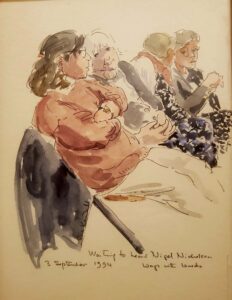
Diana and Joan Austen-Leigh waiting for Nigel Nicholson to speak at Dartington Hall, 1994

4 comments
Skip to comment form
So glad you’re better, Diana, and able to write again.
Thank you, dear Jo! Doing well, and hope you are too. xxxx
What a beautiful reminiscence of your friendship, Diana, and a fascinating peek into Austen’s desk! Thank you for sharing!
Thanks for your kind comment, Christina! I do like to throw in a little Jane-related non fiction now and then. I’m amused to recollect that it was Joan Austen-Leigh who told me (after reading a non fiction and a fiction book of mine), “You know, Diana, I think you’re really a non fiction writer.” I felt slightly ruffled at the time, but I see her point now. All my fiction is with Jane Austen’s own invented characters! And I love writing memoir, biography, observations. There’s room for both in a writing life…