
Why I Sent Darcy and Elizabeth Somewhere Pemberley Couldn’t Save Them
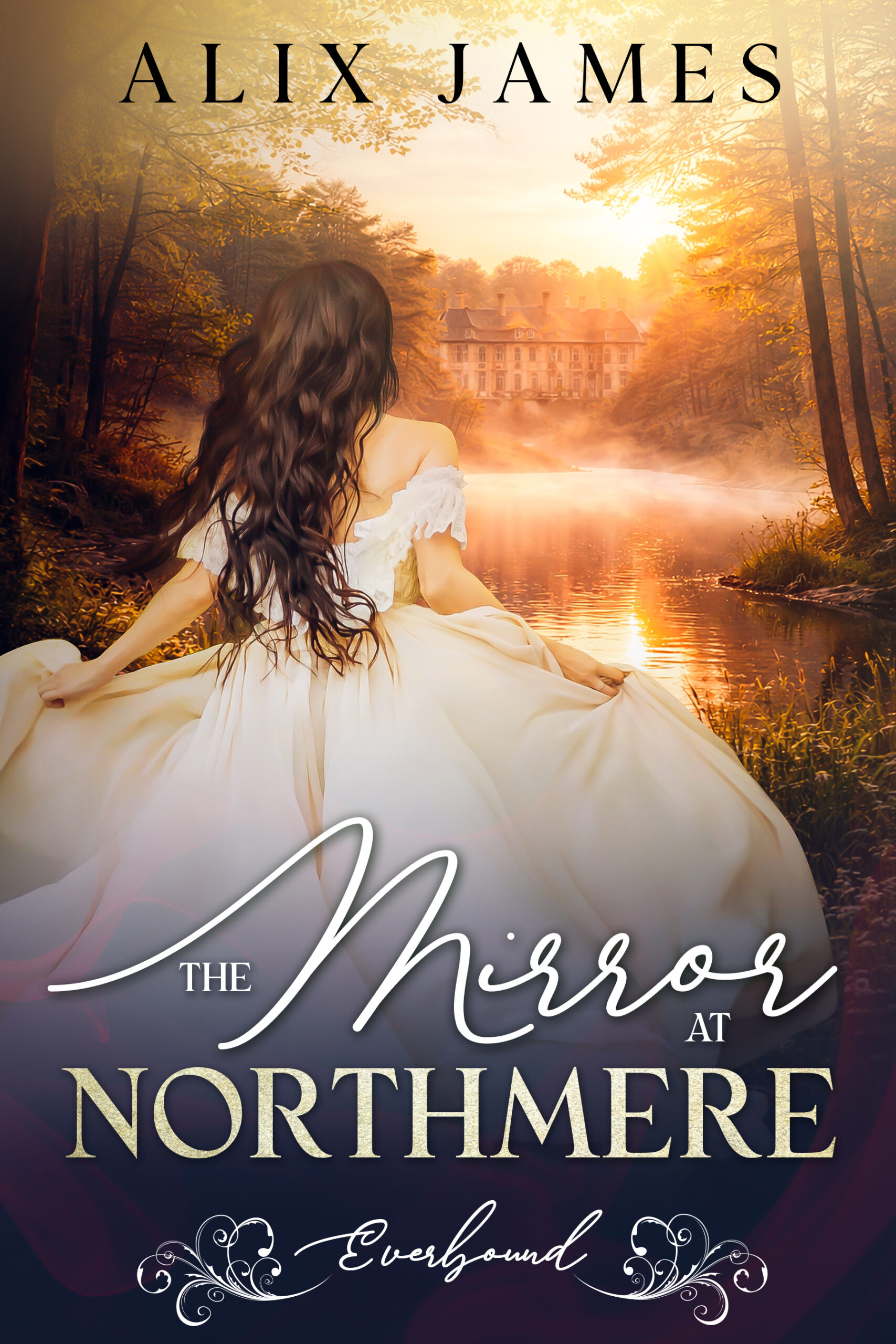
Today is release day for The Mirror at Northmere, the third book in the Everbound Chronicles. It is, like its predecessors, a Regency romantasy and a Jane Austen variation — and like its predecessors, it begins with a question I could not answer inside Pride and Prejudice itself.
What if Elizabeth Bennet’s wit, the quality we most love her for, had nowhere safe to go?
In Austen’s novel, Elizabeth’s intelligence is a defense — a way of holding her own in drawing rooms where her family’s circumstances offer her no real protection. She wields it beautifully. But she never has to use it for anything more serious than refusing Mr. Collins and surviving Lady Catherine. The wit is allowed to remain ornamental because the world, in the end, accommodates her.
I wanted to write the Elizabeth whose world did not accommodate her. The Elizabeth whose father died too soon, whose entail closed around the women he left behind, whose cleverness had to become something more dangerous than clever.
So, she forges a letter.
What she signed, and in whose hand, and why — those are the book’s to tell. What matters here is that she did it to protect what remained of her family, and that she would do it again.
Forgery in 1811 was a capital crime. The era was called the Bloody Code — over two hundred offenses carried the death penalty. The more likely sentence for a gentleman’s daughter was transportation to Australia for seven to fourteen years, which is to say, never coming back. The William Booth case, which finally turned public opinion against hanging forgers, was a year away.
That is the Elizabeth who arrives at Northmere — running north, toward Jane, in the dead of winter, hunted.
And then there is Darcy.
I love Austen’s Darcy. I love how she lets us see him slowly: through prejudice, then through Pemberley, and through the letter that changes everything. But there has always been a question her novel does not ask, because it does not need to.
Why is he like that?
Why is the master of Pemberley so contained, so exact, so wary of warmth that even his housekeeper notices it as the absence of his father? Mrs. Reynolds tells Elizabeth that old Mr. Darcy was the best landlord, and the best master. She means it as a compliment to the son. But Austen lets that comparison sit there, unexamined.
I examined it.
The Darcy of The Mirror at Northmere grew up in a house where what he saw and what he was told he saw did not match. Old Mr. Darcy was the gracious host the county remembers — warm, generous, beloved. He was also a man whose moods reversed without warning, whose promises evaporated by morning, whose dismissals on Friday undid the affection of Tuesday. And when the boy noticed — when he asked, when he held up the contradiction — he was told, gently, repeatedly, that he was mistaken. That his father had not said that. That his father had not meant it that way. That he was a sensitive child who imagined slights where none existed. The steward — old Mr. Wickham — kept the books in fiction and the surface in beautiful order, and the household closed ranks around the comfortable story of a great man and his oversensitive son.
By the time he was fourteen, Darcy had learned two things: that his father could not be trusted, and that he himself could not be trusted to know what he was seeing. The Pemberley that Mrs. Reynolds praises was, behind the door, a household held together by a boy who managed schedules for Georgiana, intercepted moods before they reached her, and second-guessed every perception he had because he had been taught his perceptions were unreliable.
That is the boy who became Darcy. Control was never coldness. Control was love — and it was also the only ground he could stand on when he had been taught to distrust the ground itself. If the accounts balanced to the penny, they could not be argued with. If the tenants were cared for within documented terms, the terms were the truth. He built a fortress of facts because facts were the one thing no one could tell him he had imagined.
Which brings us to Northmere itself.
Northmere is a ruined estate Darcy did not want and did not visit. He inherited it from a weak relative whom George Wickham, posted there as steward, hollowed from the inside — exactly the way his father once hollowed Pemberley. Darcy heard the rumors and looked the other way, because looking would have meant naming what his own father had been. The price of that silence is the dead meadows, the failing village, the lake that has been going darker for twenty years.
He has come to sell it. He has also come because the waters at Northmere were once said to heal, and Georgiana needs healing, and a brother who has tried every London physician will try a half-ruined estate and a lake nobody trusts anymore if it means another chance. But the waters are not working. Each day he watches his sister no better than the day before. Each day he opens another ledger and watches the estate’s case for survival grow thinner. He came to sell. He came to save her. He is failing at both.
Then a woman falls through the ice.
The mere is the romantic engine of the book, and it does something I have not asked water to do before. It is not a sublime, overwhelming presence like the ocean of The Lantern Keeper’s Promise. It is intimate. Mirror-still. Scaled to the human body. The mere shows you yourself standing next to the person you love and forces you to reckon with what your own face is telling you.
It is clear when they are honest. It goes dark when they lie.
And it has been waiting twenty years for someone to tell it the truth.
This book is the third in a trilogy whose connections are thematic rather than plot-based. Each book is a standalone. Each book asks what a different element of the natural world demands of the people who encounter it. The land answers. The flame illuminates. The mirror reflects.
The mirror is the hardest of the three. The land can be survived by caring for others. The flame can be tended by connection. The mirror asks something neither Elizabeth nor Darcy is prepared to give: the willingness to be seen.
She has been hiding a capital crime. He has been hiding a self-doubt he cannot bring himself to confess. Both of them are people who learned early that survival means concealment — Elizabeth behind her wit, Darcy behind his control. The mere does not care. The water keeps nothing hidden.
For readers who have followed the Everbound Chronicles from The Lady of the Thorn through The Lantern Keeper’s Promise: this is the book where the cost is exposure. Not blood, not absence. Visibility. The thing Austen’s Darcy spends an entire novel learning to risk, and Austen’s Elizabeth spends an entire novel learning to allow.
For readers new to the series: come in here. Northmere is its own valley, its own water, its own story. You will meet Elizabeth at the moment she stops being able to hide, and Darcy at the moment he discovers that he has been hiding all his life.
The Mirror at Northmere is available today! I’m giving away two copies in the drawing.
If you’ve read this far and you love what Austen variations can do when they take the source material seriously — its silences as much as its sentences — I would love to have you with me at Northmere. The water is waiting.

33 comments
Skip to comment form
Oooo, sounds like a winner to me! And another beautiful cover!
Author
Thank you, Danielle! I think… pretty sure, anyway, it was the same photographer for all three of the Everbound books. I just love the movement in those gowns. Enjoy the story!
Well, I am totally confused by your description! But I think you meant to do that, to entice us to read it. I’ve decided to read your book, and find out what you’re talking about. I look forward to it!
Author
Well, I hope the book clears the picture for you, Ginna. Enjoy!
I like the stories where Darcy definitely has to step out of his comfort zone. I don’t know how Elizabeth is doing the same (what her forgery is about), but I’m looking forward to seeing it!
Author
Enjoy, Michael!
This sounds so intriguing! I am especially fascinated by Darcy’s past with an untrustworthy father he tries to cover for.
Author
It definitely shapes his character, Heather. Enjoy!
Wow! Another exciting book. Congratulations and thanks for the preview.
Author
Thank you, Jennifer!
This is so intriguing! Thanks for offering a giveaway!
Author
Good luck, Jennie!
I’m currently reading this and am so drawn into the story! I loved the first two in this series and I’m already loving this one. I feel for all four, Darcy, Georgiana, Jane and especially Elizabeth and I’m desperate to see where it goes. Please don’t enter me in the drawing. 🥰🥰🥰
Author
Oh, I love hearing that, Glynis! Thank you!
This sounds fascinating.
Author
I hope you enjoy it, Debbie!
What an interesting take. I’d enjoy reading this. Thanks for sharing with us and congratulations on the new book!
Author
Thank you, Laura!
Would love to read!
Author
I hope you enjoy it, Darcy!
This story sounds fascinating. I’ve added it to my TBR list. ;o)
Author
Ooh, I hope you love it, Cimora!
The questions you are asking of Elizabeth and Darcy look to be making a very intriguing story. I would love a giveaway.
Author
I hope so. Good luck in the drawing, T!
Sounds like a story I would enjoy.
Author
I hope you do, Sheila!
This is an exciting direction you’ve set for JAFF. I’ve enjoyed your work so much through the years. I’m looking forward to reading this latest offering. Thanks for keeping at it!
Author
What a lovely thing to say, Tina! Thank you for sticking with all my Darcy and Elizabeth whims over the years. <3
You caught my attention.
Congratulations on the new release!
Author
Lovely! Enjoy, Linda!
I hope I can read it soon! Thanks for the preview.
Author
Good luck in the giveaway, Kattia!
This looks really interesting. Good luck with the new release!